Can You Lay Water Pipes Under a Screed?
Yes, but only if certain conditions are met: the pipe must run in one continuous length with no joints in the concrete, sit in protective sleeving or insulation, and be pressure-tested before the pour. PE-X, PE-RT, multilayer pipe, copper and corrugated stainless steel are suitable. Threaded, collet and compression joints must never be embedded in screed: if one leaks, the floor has to be opened up.
Why are pipes hidden in screed, and what are the risks?
Concealed routing keeps pipes out of sight, frees up space and protects them from accidental knocks. Dust does not collect on pipes in a screed, and the pipe sits in a stable environment.
There is also one major drawback: if the pipe leaks, you have to break open the floor. That is expensive and slow, so every detail of the installation should be treated as work that cannot be redone. Expansion is a separate problem: a hot-water pipe lengthens when heated and a cold one collects condensation, and without a protective layer both damage the screed or leave it damp.
Which pipes are suitable for embedding in screed?
The material has to meet four requirements: flexibility so it can be laid in one piece, low thermal expansion, corrosion resistance and durability. The following fit:
- cross-linked polyethylene PE-X and PE-RT: flexible pipe in coils, so the loop is laid without joints;
- multilayer (metal-plastic) pipe: acceptable if every joint is kept outside the screed;
- copper: reliable and laid in insulation, but expensive and requires soldering;
- corrugated stainless steel: it bends and absorbs expansion.
Black and galvanised steel are not recommended because of corrosion, nor is rigid polypropylene: it bends poorly, expands noticeably and needs many joints.
How do you lay a pipe in screed correctly?
- Level the base and lay edge insulation tape around the perimeter of the room.
- Roll the pipe out in one piece from the manifold to the draw-off point, with no joints within the screed.
- Fit protective corrugated sleeving or foamed-polyethylene insulation over the pipe: it takes up expansion and protects against condensation.
- Fix the pipe with clips or fixing tape so it cannot float up during the pour.
- Bring every joint out to the manifold or to accessible inspection points.
- Pressure-test above the working pressure, usually 1.5 times, and keep the pressure on until the pour is finished.
- Pour the screed and let it gain strength before loading the floor.
Why are joints in a screed dangerous?
The great majority of leaks in concealed pipes occur at joints rather than in the pipe itself. Compression and threaded fittings loosen over time from temperature cycling and vibration, so they need to stay accessible for tightening. Burying such a fitting in concrete means planning to open the floor later.
If a joint in the screed is unavoidable, use only permanent methods: a press fitting or welding. It is better, though, to change the layout so that tees and couplings end up in a shaft, a manifold cabinet or under a removable hatch. Run hot and cold water in separate pipes, each in its own insulation.
What about HDPE pipe and the water service into the house?
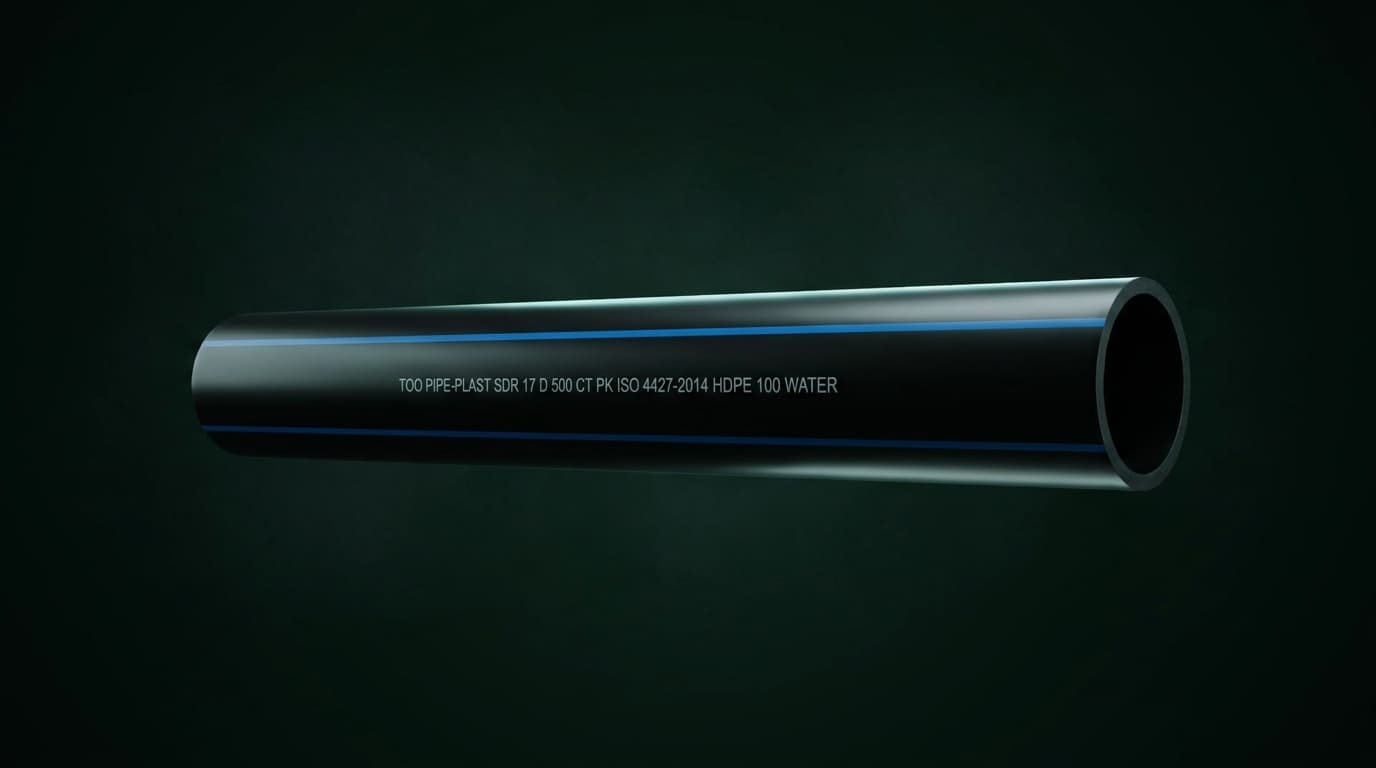
PE100 polyethylene is not normally used for internal runs in screed: it is stiffer than PE-X, does not bend as easily to a small radius, and its compression fittings must not be buried in concrete. But it suits the incoming service that passes under the floor or foundation: the pipe is supplied in 50–200 m coils, so the service can be laid in one piece with no joints, inside a protective sleeve.
For water supply to GOST 18599-2001, PE100 SDR17 (PN10) or SDR11 (PN16) is suitable, and these are pipes we produce. The service ends where it enters the house, and the internal distribution is then made from materials intended for indoor systems.
Frequently asked questions
- Does a pipe embedded in screed need sleeving?
- Yes. Corrugated sleeving or tubular foamed-polyethylene insulation lets the pipe move as it expands, protects it from being scratched by concrete and, on cold water, prevents the condensation that leaves a screed damp.
- What pressure is needed for the test before pouring?
- The test pressure is usually taken as one and a half times the working pressure, but the exact value and hold time are set by the design and the pipe manufacturer's instructions. The gauge is left connected during the pour so any damage is noticed at once.
- Can hot-water pipes be embedded in screed?
- They can, if the pipe is continuous, insulated and expansion is allowed for. Without insulation a hot pipe loses heat into the concrete and lengthens noticeably, which leads to cracks. It is better to run hot water along walls in a chase or along the ceiling.
- Will the floor have to be opened up after many years?
- Not usually, if the pipe was laid correctly in one piece without joints. The main reasons for opening a floor are fittings buried in concrete and mechanical damage to the pipe during installation. So the key things are installation quality and testing before the pour.