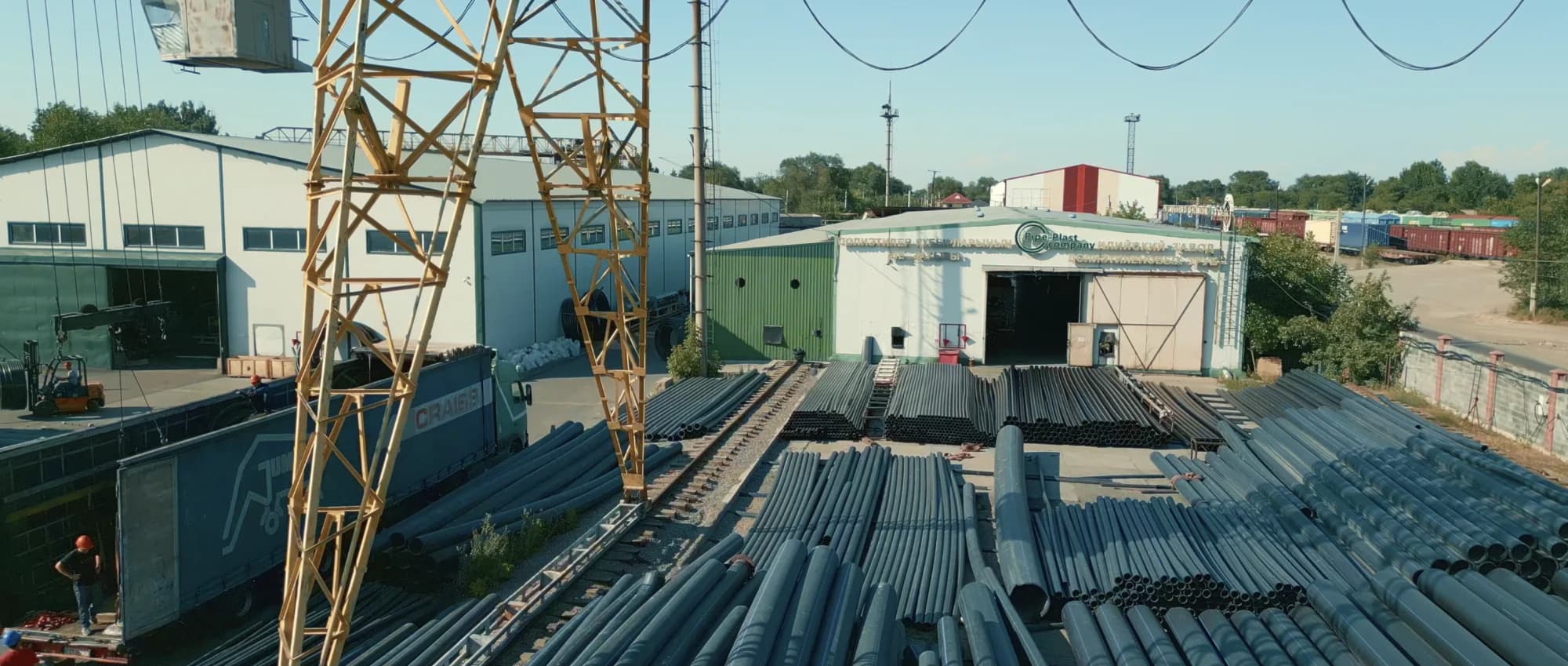
Plant in Almaty Region. Open for visits.
8 production lines, quality control at every stage, diameters up to 1200 mm. Want to see it for yourself — come for a tour.
Book a Factory Tour- production lines
- 8
- working production capacity
- 70 t/day
- diameters, mm
- d20–1200
- large thick-wall diameters
- SDR 33–7.4
How is an HDPE pipe made?
HDPE pipe production begins with virgin polyethylene granules. The granules are fed into an extruder where they melt and are forced through a die by screw pressure, forming a continuous pipe. The hot pipe passes through a vacuum cooling bath, is calibrated to the required diameter and wall thickness, marked, and wound into coils (small diameters) or cut into 6–12 m lengths (large diameters). Pipe-Plast operates 8 parallel lines, reducing lead times compared with plants that have 3–6 machines. At every stage, geometry, density, and compliance with GOST 18599-2001 / ST RK ISO 4427-2014 (water) and ST RK GOST R 50838-2011 / ST RK ISO 4437-2014 (gas) are verified. Co-extruded and multi-layer pipes are formed directly in the molten mass, with layers fused at the extrusion stage. Finished products are supplied with a quality certificate and certificates of conformity.
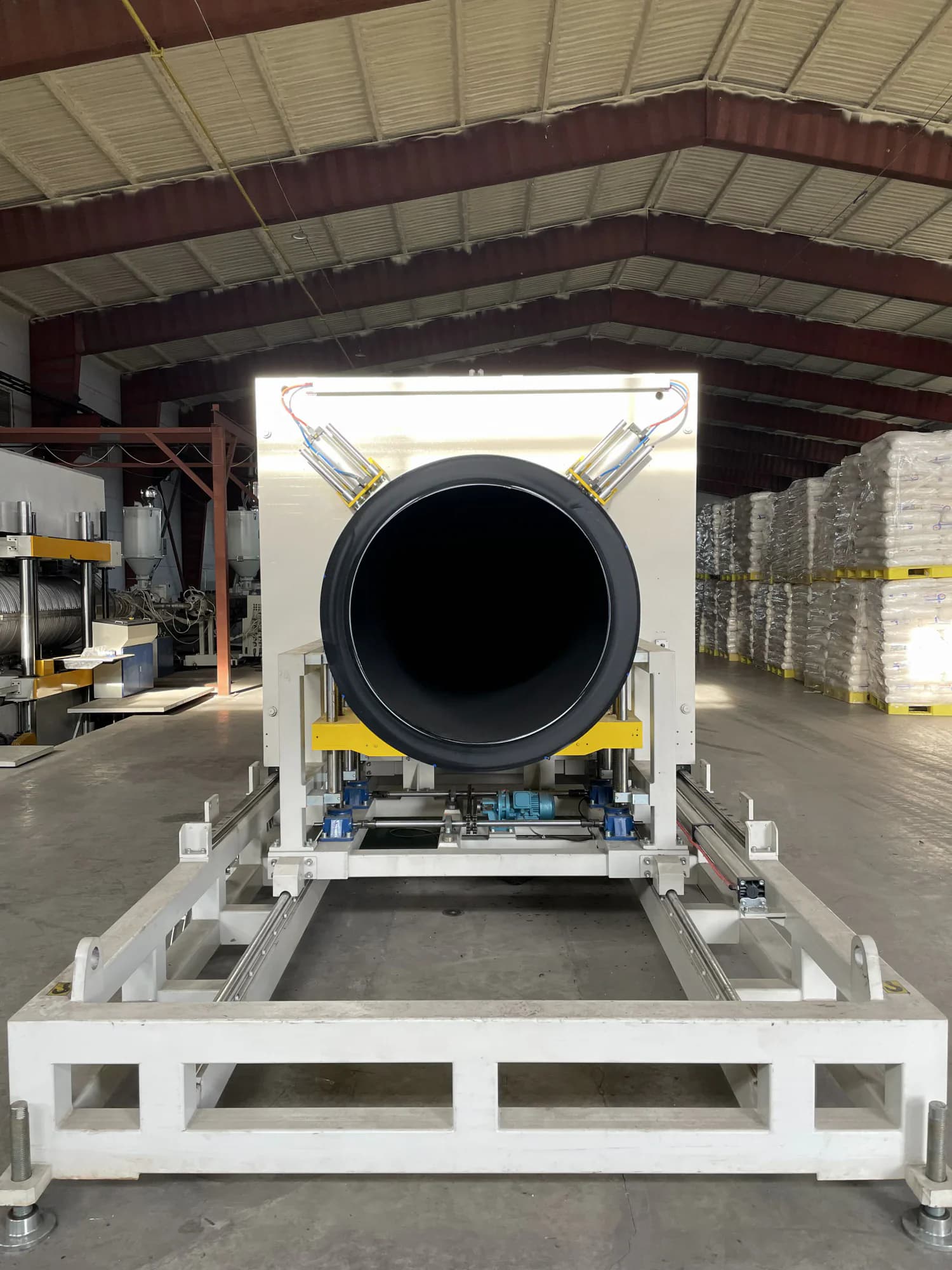
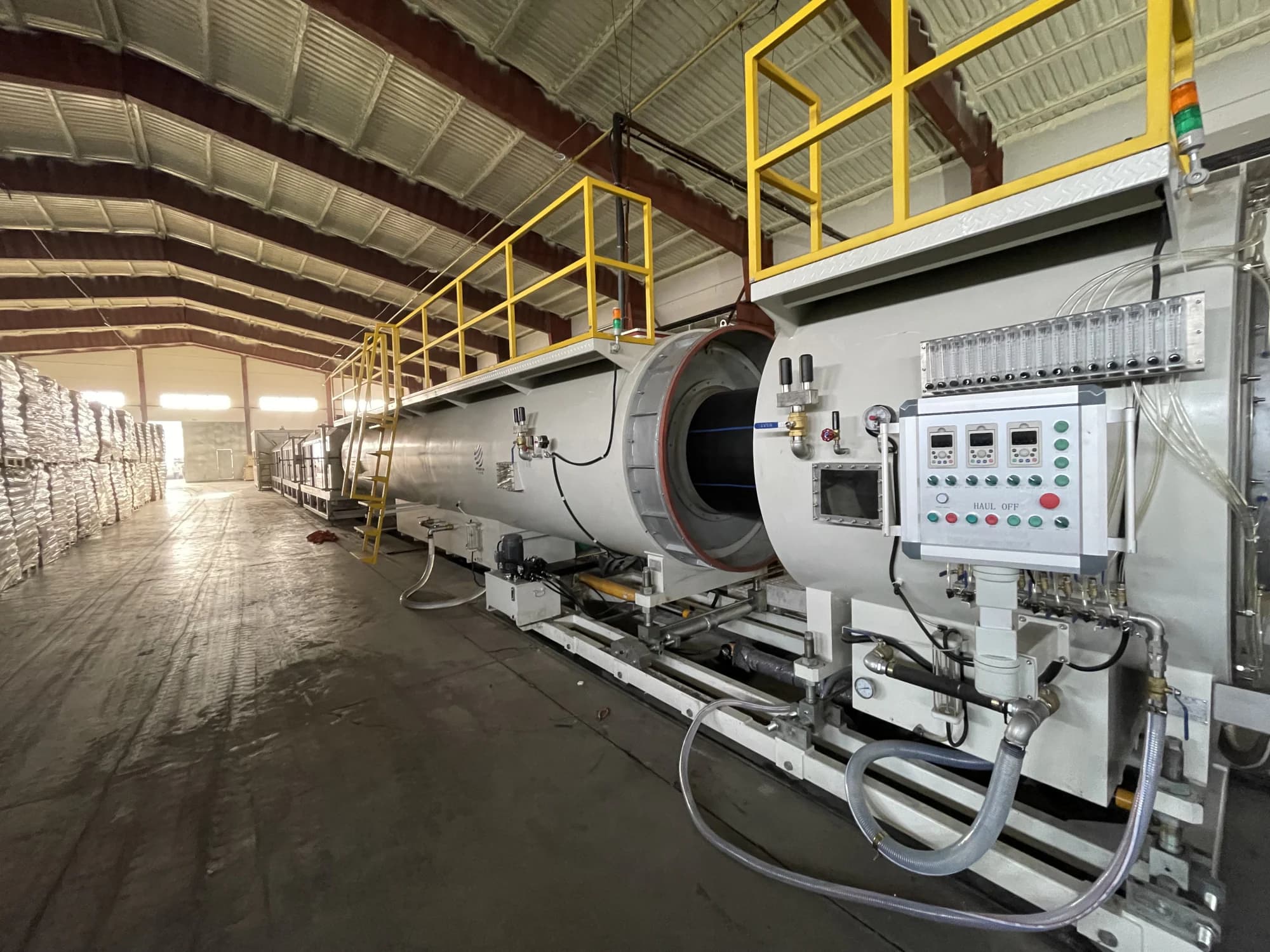
8 parallel lines — shorter lead times, wider diameter range
Why do only a few plants produce thick-wall large-diameter pipe?
When pipe of 710–1200 mm is extruded, molten polyethylene tends to flow downwards under its own weight — an effect known as sagging. For most manufacturers it causes wall thickness variation and rejects, which is why thick-wall large diameters are rare on the market. Pipe-Plast produces them in series: 710–800 mm in SDR 9 and 900–1200 mm in SDR 11. The plant in Almaty Region runs Battenfeld Cincinnati extrusion lines, and the extrusion protocol is followed at every stage — from melt feed to shape fixing.
- 710–800 mm · SDR 9
- 900–1200 mm · SDR 11
We make what others turn down: high-strength pipe for the most demanding projects.
Line power and stability
Battenfeld Cincinnati equipment is built for extreme loads and continuous melt feed without pressure drops.
Engineering expertise
Precise tuning of temperature zones and haul-off speed for every pipe size.
Multi-circuit cooling
The shape is fixed instantly and evenly right at the die exit — the wall does not sag.
Our 8 Production Lines
- Lines 1–6: standard diameters d20–630.
- Lines 7–8: large diameters d710–1200 (up to 1000 SDR11, 710 SDR9) — unavailable at most competitors.
- Specialisation: co-extrusion and PP-coated pipes d200–630.
What equipment do the plant's extrusion lines use?
Automatic dosing systems
Distribute carbon black — the UV stabiliser — and process additives evenly through the whole melt.
Centralised vacuum drying and material feed
Keeps dust, moisture and foreign particles out of the melt.
Automatic planetary cutting units
A clean 90° cut with no chips or burrs — welding on site goes faster.
Servo-driven multi-track haul-off units
Smooth pulling force with no dents or deformation on the hot pipe.
How is quality controlled at every production stage?
The Pipe-Plast extrusion protocol has five stages — from incoming granule inspection to hydraulic testing of the finished batch. Geometry, wall thickness and standard compliance are recorded at each of them.
- 01
Incoming material control and gravimetry
Only certified virgin PE 100 polyethylene goes into production. A gravimetric system doses material in real time according to line speed, which eliminates wall thickness variation and holds the specified wall along the whole pipe.
- 02
Plastication and combined extruder cooling
Battenfeld Cincinnati screw assemblies deliver a homogeneous melt with no overheating, polymer degradation or air bubbles. Combined internal cooling — water, oil and air — keeps the temperature balance and preserves the physical and mechanical properties of the material.
- 03
Vacuum forming and cascade cooling
The pipe takes its exact diameter, from d20 to d1200 mm, in vacuum calibrators. Gradual heat removal in a cascade of water baths releases internal stress: the pipe does not deform during transport, installation or operation under pressure.
- 04
Permanent laser marking
Diameter, SDR, standard, date and batch number are burned by laser directly into the polymer. Such marking does not rub off against soil, is not affected by UV and stays readable after long outdoor storage.
- 05
Final laboratory control
Every batch is checked for geometry accuracy, weight and ovality, then undergoes hydraulic testing for resistance to long-term internal pressure. A quality certificate is issued for the batch.
ГОСТ 18599-2001 / СТ РК ISO 4427-2014 · СТ РК ГОСТ Р 50838-2011 / СТ РК ISO 4437-2014
Want to see it for yourself?
We welcome all clients — just let us know in advance.
Almaty region, Iliysky district, Otegen Batyr village, Zheruyyk st. 13