Which Pipe to Use for a Borehole Pump and for Casing
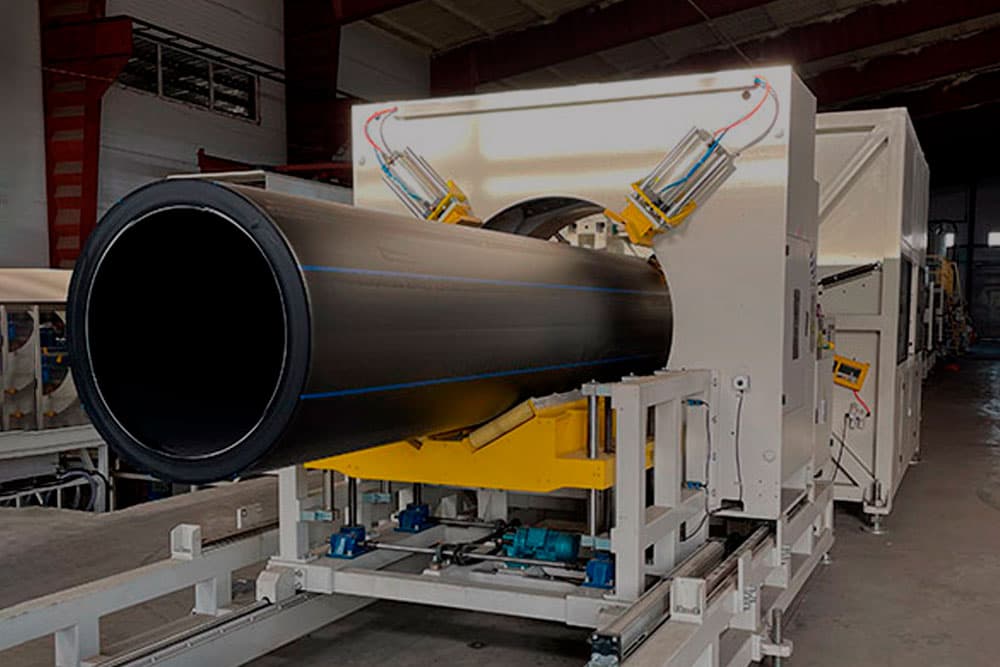
For a submersible pump you usually take PE pipe 32 mm in diameter, class PN10–16, as one piece with no joints under water and with a safety cable. The casing string is more often made of threaded uPVC or steel; PE as casing is used with caveats, and the drilling company decides the material and diameter from depth and geology.
Which pipe does a submersible pump need?
Water rises from the pump along the rising main. A pressure PE100 polyethylene pipe suits it: it does not rust, is flexible and comes in a coil, so you can take a length for the full depth and on to the house without a single joint. Such pipes for drinking and utility water are made to GOST 18599-2001, and we make them.
The main rule: there must be no joints in the borehole itself, under water. Any connection in the shaft risks a break and the loss of the pump, which would be hard to recover. If joints are needed, they are moved up to the surface, to the wellhead.
Which diameter and pressure class should you choose?
Most often 32 mm is chosen: it is the best compromise between carrying capacity and price. A 25 mm pipe reduces pump output and is fitted in low-yield boreholes so the pump does not draw water faster than it arrives. 40 mm is for powerful pumps and long routes.
The pressure class is chosen from the pump head plus the water column in the pipe. For a small depth PN10 (SDR17) will do, but the thin wall of such a pipe bends more easily and kinks. So many installers take PN16 (SDR11): the wall is thicker, the pipe keeps its shape and handles installation better. Check the calculation for depth and head with the pump maker.
How do you install the pipe and pump in the borehole?
Order of work:
- Measure the borehole depth and the dynamic water level; pipe length is the immersion depth plus the distance to the house and a reserve.
- Unroll the coil on level ground and let the pipe straighten.
- Connect the pipe to the pump through an adapter and fit a check valve at the outlet.
- Fix a safety cable to the pump and the wellhead, tying the pipe and cable to it at an even spacing.
- Lower the pump smoothly, without holding it by the cable.
- Fix the string at the wellhead and connect the supply to the house.
- Start the pump and flush the borehole until the water is clear.
The cable and fixing are needed so the pump does not fall if a pipe or joint fails.
What plastic casing pipes are there?
Casing holds the borehole walls and stops the ground from collapsing. Plastic casing strings are common today because they do not rust and need no welding.
The most widespread are uPVC casing pipes with threaded ends: they are assembled quickly without welding. PE casing pipes are more often installed inside a steel string as a liner for clean water; a standalone PE string is possible but limited in depth, because polyethylene is softer than PVC and deforms more under soil pressure. The casing diameter is chosen from the pump size: the inner diameter must let it pass freely.
PE or PVC for casing: which should you choose?
There is no single answer; it depends on geology and depth.
- uPVC: rigid, threaded, quick to assemble, suits most shallow boreholes; it fears hard impacts and severe cold during installation.
- PE: flexible, impact resistant, not afraid of cold or soil; softer and needs welding or special joints.
- Steel: strong at great depth, but corrodes and costs more.
The drilling company determines the material, diameter and wall thickness. If the borehole is to give drinking water, the pipe must be marked and come with documents confirming its suitability for drinking water supply.
How do you look after the pipe and pump after installation?
After start-up a few simple rules are enough:
- do not let the pump run dry;
- watch the yield and the turbidity of the water: sand wears a pump quickly;
- when lifting the pump, do not pull on the cable; hold the string by the pipe and the safety cable;
- lay the pipe from the borehole to the house below the frost depth or insulate it.
If output has dropped, first inspect the pump, the check valve and the joints at the wellhead, and only then decide whether to replace the pipe: polyethylene does not scale up or rust by itself.
Frequently asked questions
- Can a 25 mm pipe be used for the pump?
- It can for a low-power pump and a low-yield borehole. But 25 mm limits the flow, so for standard submersible pumps 32 mm is more often taken. Choose the size from the pump datasheet.
- Is a safety cable needed for the pump?
- Yes. If the pipe or a joint breaks, the cable will hold the pump. It is fixed to the pump and the wellhead, and the pipe with the cable is tied to it at an even spacing.
- Can polypropylene be used in a borehole?
- It is not recommended. Polypropylene is rigid and does not come in coils, so joints would be needed, and in a borehole shaft they are risky. For the rising main, PE pipe is taken as one continuous length.
- Is a technical pipe suitable for drinking water?
- For drinking water take pressure pipe to GOST 18599-2001: the standard covers drinking and utility water lines. The pipe must be marked, and the supplier must have conformity documents.