Joining HDPE Pipes: Fittings, Welding and Transition to Metal
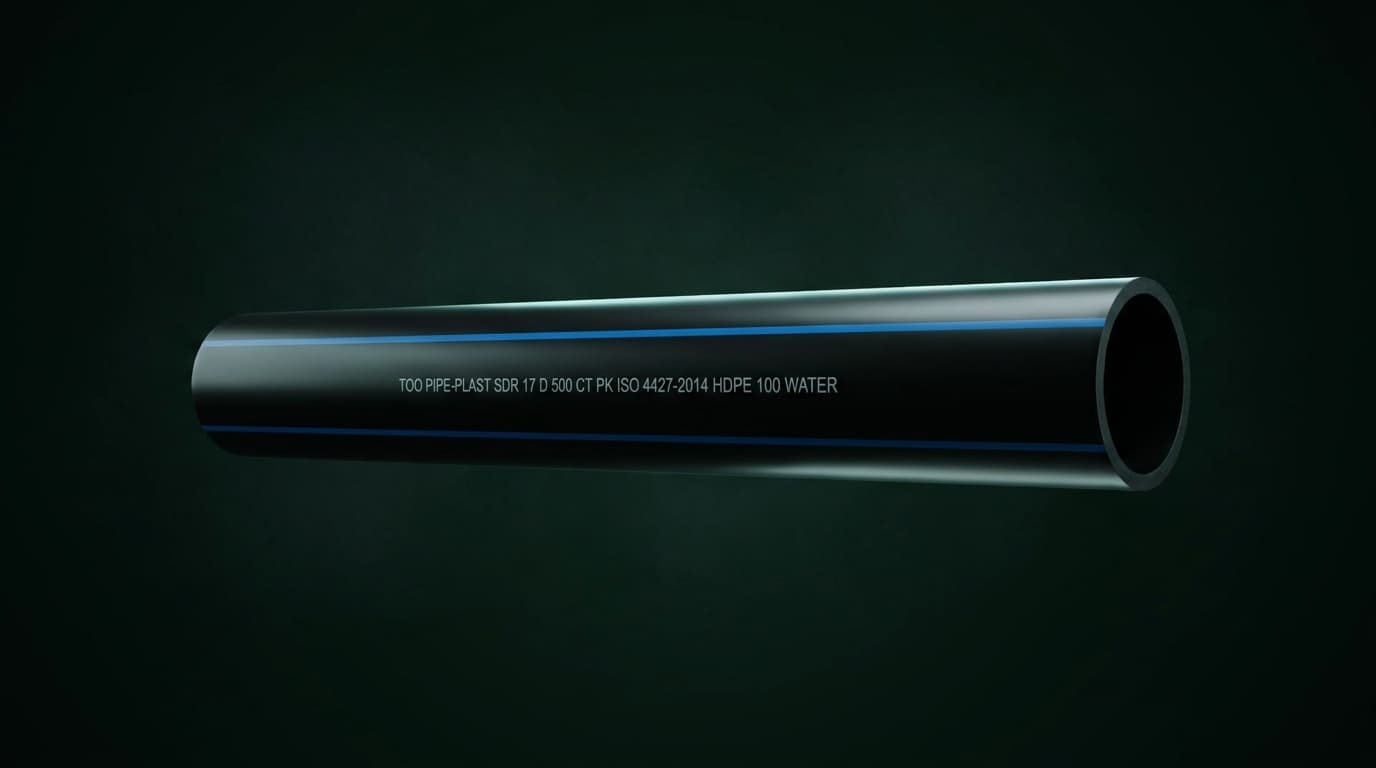
HDPE (polyethylene) pipes are joined with compression fittings, butt fusion, electrofusion, socket fusion and flanges. For garden and household water lines of small diameter, up to about 110 mm, compression fittings are enough. Butt fusion is used from 63 mm on mains; electrofusion couplings suit any diameter, gas and cramped conditions. A thread is never cut on the pipe itself: to join the pipe to metal use a threaded fitting or a flange.
What methods of joining HDPE pipes exist?
- Compression fittings: demountable, no equipment needed, for small diameters up to about 110 mm.
- Butt fusion with a heating tool: pipe ends are melted on a heater plate and pressed together; from 63 mm, the main method for mains.
- Electrofusion: a coupling with a built-in heating coil is slipped over the pipes and current is applied; any diameter, gas, trenches and chambers where a machine cannot be set up.
- Socket fusion: usually small diameters; the outside of the pipe and the inside of the socket are melted.
- Flange joint: for valves, pumps, demountable assemblies and the transition to metal.
The choice depends on diameter, pressure, the place of installation and whether the joint must be demountable.
Which method should you choose by diameter?
For small diameters (irrigation, a garden water line, a house inlet) compression fittings are suitable: quick, with no machines. Small-diameter pipe is supplied in coils of 50 to 200 m, so it is laid in one piece and there are few joints. For diameters up to about 110 mm compression fittings are also acceptable in household work, but for a permanent buried network welding is more reliable. From 63 mm and up on mains, butt fusion is used: the joint is monolithic and there are no extra parts. For gas, tie-ins, repair inserts and cramped places choose electrofusion couplings. The larger the diameter and the pressure, the less sense it makes to economise on welding: a mistake on such a joint costs more.
How do you install a compression fitting?
Choose the fitting (coupling, tee, elbow) by the pipe's outside diameter and the pressure class, for example PN10 for SDR17.
- Cut the pipe square with a pipe cutter, with no burrs on the end.
- Remove the inner burr with a calibrator or a file and wipe the end free of dust and soil.
- Take the fitting apart: unscrew the nut, remove the clamping ring and the seal, and note the order.
- Slip the nut, the clamping ring and the seal onto the pipe in the order they sat in the fitting.
- Mark the insertion depth with a marker and push the pipe into the body until it stops.
- Tighten the nut by hand, then with a spanner by 1 to 2 turns as the manufacturer instructs, without excessive force: you can damage the seal.
- Open the water slowly, bleed the air and check the joint at working pressure.
How do butt fusion and electrofusion work?
In butt fusion the pipe ends are squared with a facing tool, melted on a heater plate, the plate is removed, the ends are pressed together and held until cooled. The joint is monolithic, and quality depends on the machine and a trained welder: pipes of the same diameter and wall thickness (SDR) from compatible materials are welded. In electrofusion the pipe is scraped to remove the oxidised layer, held in an alignment clamp, the coupling is slipped on and connected to the machine, which supplies current according to the coupling's parameters. This is the only method suitable for repairing buried mains and for gas. Welding of gas pipes is carried out only by qualified specialists.
How do you join polyethylene to metal?
A thread cannot be cut on the PE pipe itself: the wall would be weakened. For the transition to steel or cast iron use:
- a compression fitting with an external or internal metal thread: a clamp on the pipe at one end and a steel thread at the other; for household water supply;
- a flange joint: a flange adapter is fused to the PE pipe, a loose steel flange is slipped over it and bolted to the mating flange; for valves and large diameters.
For gas, the polyethylene-to-steel transition is made as a permanent joint at the inlet and only an authorised organisation does it. For water supply, PE100 SDR17 to GOST 18599-2001 is suitable, and we manufacture such pipes; fittings are chosen by diameter and pressure class.
Frequently asked questions
- Can HDPE pipes be joined without fittings?
- Yes, by welding: butt, electrofusion or socket. Without fittings and without welding polyethylene cannot be joined: glues do not hold on it. For one-off household jobs compression fittings are simpler.
- Can a compression joint be taken apart?
- Yes: unscrew the nut and the pipe comes out of the fitting. The seal and clamping ring can usually be reused, but if they are worn it is better to replace the fitting. This is the main advantage over welding.
- Can a compression fitting be buried in the ground?
- Household water lines are sometimes done this way, but it is better to keep fittings accessible in a chamber or inspection pit: then a leak is easier to notice and the joint easier to service. Mains and gas are joined by welding.
- What is the difference between HDPE and PE100 in marking?
- HDPE (ПНД) is the colloquial name for high-density polyethylene. Pressure pipes are marked by the material's strength class: PE100. It is the same polyethylene, with the strength class stated.