How a PE Pipe Differs from an HDPE Pipe, and Where LDPE Fits
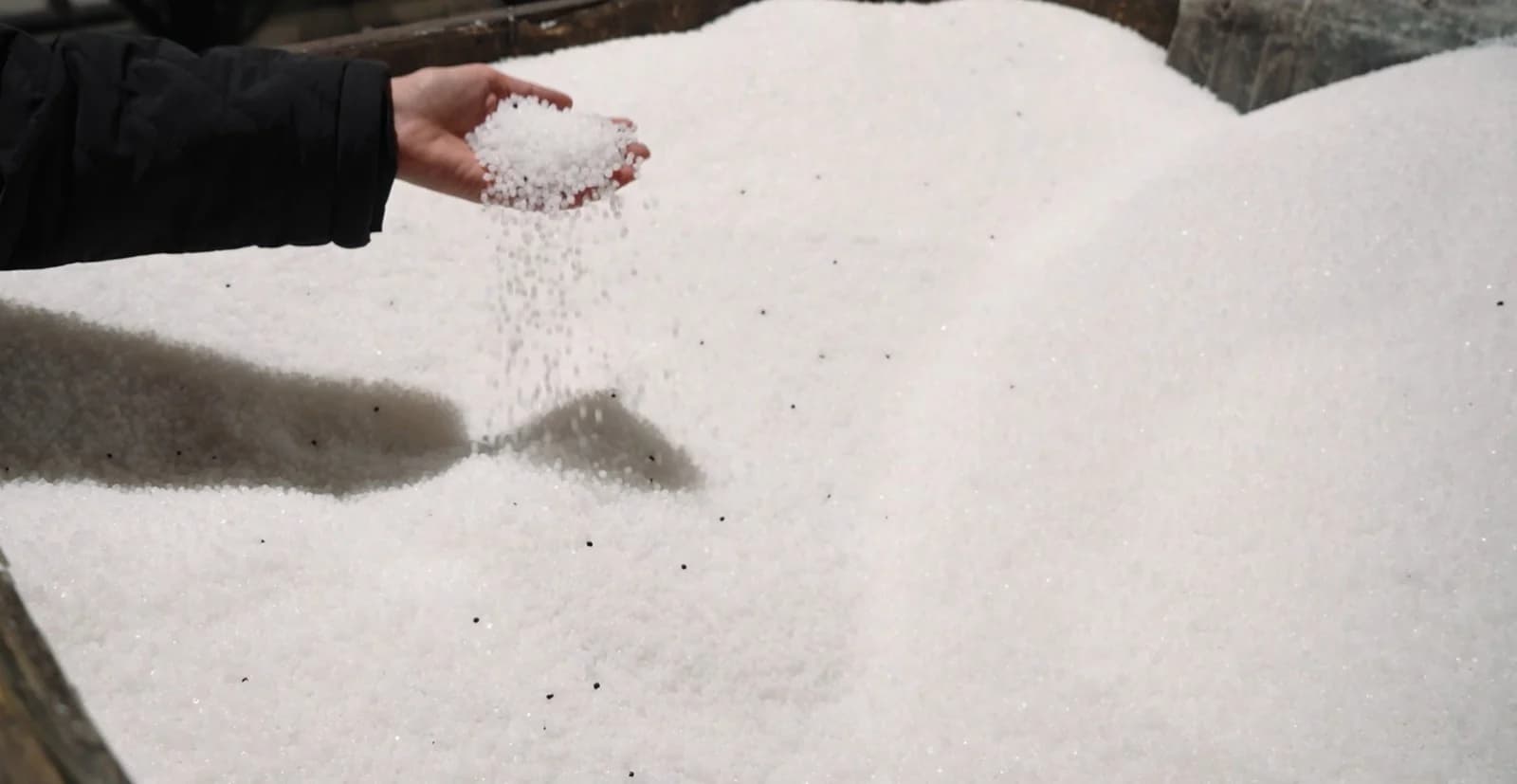
PE is the general name for polyethylene, and HDPE (ПНД in Russian) is one type of it: polyethylene made by the low-pressure process, also called high-density polyethylene. Its counterpart is LDPE (ПВД), made at high pressure and of lower density. The terms low and high pressure describe how the material is produced at the plant, not the water pressure in the pipe. Pressure pipes for water and gas are made from HDPE, in grades PE80 and PE100.
What do PE and HDPE (ПНД) mean?
PE is polyethylene as a class of materials. So a PE pipe is the most general name: it fits both a pressure water pipe and a soft thin tube.
ПНД (low-pressure polyethylene) is HDPE in English marking: high-density polyethylene. This is what pressure pipes are made from: in everyday use a PE pipe and an HDPE pipe almost always mean the same thing. A PE100 pipe, for example, is HDPE of grade PE100.
So PE and HDPE are not opposites: HDPE is one type of PE, and the most common one in pipelines.
Why is polyethylene called low-pressure and high-pressure?
The names come from the technology used to make the polyethylene itself. HDPE is produced at relatively low pressure with catalysts; its molecules have few branches and pack tightly, so the material is dense and strong. LDPE is produced by radical polymerisation at very high pressure, on the order of hundreds of MPa; its molecules are heavily branched, so the material is less dense, softer and less strong.
Hence the common confusion. Low pressure does not mean the pipe can only hold low pressure. On the contrary, HDPE pipes withstand 10, 12.5 and 16 atm and more, while high pressure refers to the synthesis conditions at the chemical plant.
How do HDPE and LDPE differ in practice?
The main differences between the materials:
- density and strength: higher in HDPE, so the pipe is stiffer and holds pressure; LDPE is softer and stretches;
- temperature: HDPE tolerates somewhat more heat, but for water it is still up to +40 °C;
- use: HDPE makes pressure pipes for water and gas and industrial networks; LDPE goes into film, hoses and thin household tubing;
- colour and durability: black HDPE with carbon black is sunlight resistant, so it can be laid in the open;
- diameters: large-diameter pressure pipes are not made from LDPE.
Because of its low strength, LDPE is unsuitable for pressure mains and underground networks.
What pressure do HDPE pipes actually withstand?
Pressure is set not by the name of the material but by the grade and wall thickness. PE100 SDR17 is rated for about 10 atm (PN10), SDR13.6 for 12.5 atm and SDR11 for 16 atm. PE100 is stronger than PE80, so at the same pressure its wall is thinner.
Pressure pipes for water are made to GOST 18599-2001 and for gas to ST RK GOST R 50838-2011. For more on pressure calculation, see our article on what pressure HDPE pipes are rated for. The service life of pressure PE pipes in a water main is up to 50 years.
How do I avoid a mistake when buying a pipe?
Do not rely on the words low pressure or high pressure in a listing. Check three things:
- Marking: the material (PE100 or PE80), SDR, and outer diameter with wall thickness, for example 110×6.6;
- Standard and purpose: GOST 18599-2001 for water, ST RK GOST R 50838-2011 for gas; a drinking-water pipe carries a blue stripe;
- Documents: a quality passport and a certificate of conformity.
If you need a pressure pipe for water, look for PE100 at SDR17 or a lower SDR; we make such pipes at our plant in the Almaty region.
What do PE80, PE100 and PE100-RC mean in a pipe name?
Within HDPE, materials are divided by strength class. The number in the name shows the minimum required strength (MRS) in tenths of a megapascal: PE80 is 8 MPa, PE100 is 10 MPa. The higher the class, the thinner the wall at the same pressure.
PE100-RC is PE100 with higher resistance to cracking and point loads, for example from stones in the backfill. It forms the outer layer of Pipe-Plast co-extruded pipes, which we make in two-layer and three-layer versions. For an ordinary water pipe, single-layer PE100 is enough.
Frequently asked questions
- Are PE and HDPE the same pipe?
- In most cases yes: pressure PE pipes are made from HDPE, that is, high-density polyethylene. What matters more than the name is the grade (PE80, PE100), the SDR and the standard the pipe is made to.
- Are there high-pressure HDPE pipes?
- There is no such division. Every HDPE pressure pipe has a pressure class (PN), from PN6 and below up to PN16 and above. The words high pressure usually refer to LDPE and describe how the material is made, not the working pressure.
- Is PE100 also HDPE?
- Yes. PE100 is a grade of high-density polyethylene, that is, HDPE with a minimum required strength (MRS) of 10 MPa. It is the strongest of the mass-produced materials for pressure pipes.
- Can a water supply be made from LDPE pipes?
- For an outdoor pressure water main, no: LDPE is too soft and not strong enough. For the main and the house entry, use HDPE pressure pipes, PE100 with the required SDR to GOST 18599-2001.