What Pressure HDPE Pipes Are Rated For: PN, SDR and Temperature
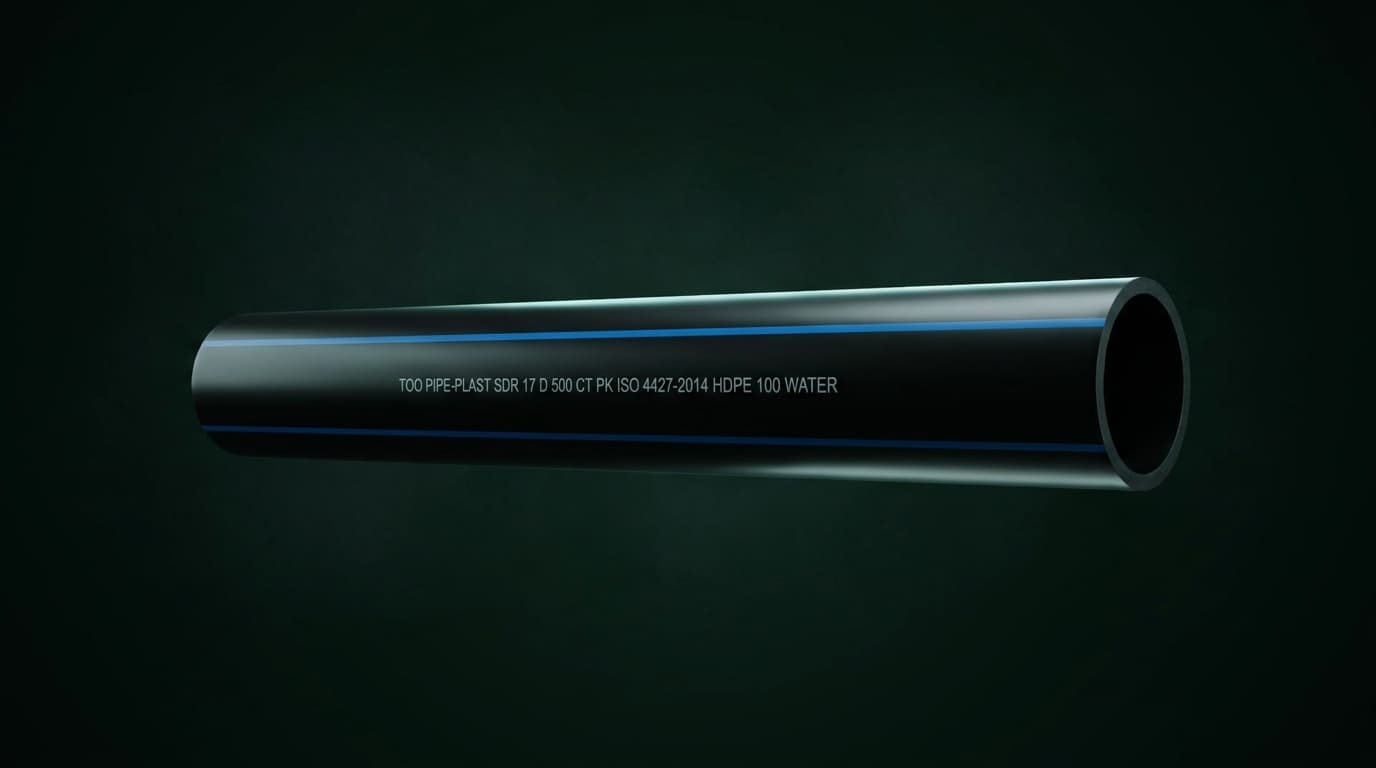
The working pressure of an HDPE pipe is set not by its diameter but by the ratio of diameter to wall thickness (SDR) and the polyethylene grade. For PE100, an SDR17 pipe is rated for about 10 atm (PN10), SDR13.6 for 12.5 atm and SDR11 for 16 atm. These figures apply to water at +20 °C; as water warms to +40 °C the allowable pressure drops by about a quarter. Cross-linked polyethylene (PE-X) is a different material, and its pressure is stated separately for each temperature.
What do PN and SDR mean on an HDPE pipe?
PN is the nominal pressure in bar (1 bar is roughly 1 atm): PN10 means 10 bar, or 1.0 MPa. It is the pressure the pipe is designed to carry for water at +20 °C over its whole 50-year service life, with a safety margin.
SDR is the ratio of outer diameter to wall thickness. The lower the SDR, the thicker the wall and the higher the allowable pressure: SDR17 is a relatively thin wall, SDR11 a thick one.
The polyethylene grade sets the strength of the material. At the same SDR, PE100 withstands more than PE80: at SDR17, for example, about 10 atm against 8, which is why PE100 allows a thinner, lighter wall for the same pressure.
What pressure does a PE100 pipe withstand at different SDR values?
For water at +20 °C, PE100 pipes fall into these classes:
- SDR17, PN10 — about 10 atm: the common choice for water mains and irrigation networks;
- SDR13.6, PN12.5 — about 12.5 atm: for trunk lines with higher pressure;
- SDR11, PN16 — about 16 atm: for high-pressure lines and demanding installation conditions.
Diameter alone does not change the pressure rating: a 32 mm and a 630 mm pipe of the same SDR withstand the same pressure; the large pipe simply has a thicker wall in absolute terms. Choose the class from the maximum pressure in the network plus an allowance for water hammer, not by eye.
How does water temperature reduce the allowable pressure?
Nominal pressure is stated for +20 °C. Polyethylene loses strength as it warms, so for warmer water the allowable pressure is multiplied by a reduction factor. Typical values for PE100 are about 0.87 at +30 °C and about 0.74 at +40 °C, so a PN10 pipe at +40 °C holds roughly 7 atm. Exact values for each temperature range are given in GOST 18599-2001.
Above +40 °C pressure PE pipes are not used for water, which is why hot water supply and heating are not built from HDPE: PE-X, PE-RT, polypropylene or metal are used instead. Cold does not harm strength: polyethylene keeps its properties in frost; the only requirement is that the water in the pipe must not freeze.
How is nominal pressure calculated?
The calculation uses standard quantities. For water: PN = 20 × MRS ÷ (C × (SDR − 1)), where PN is in bar, MRS is the minimum required long-term strength of the material in MPa (10 for PE100, 8 for PE80), C is the safety factor (1.25 for water) and SDR is the ratio of diameter to wall thickness.
Example for PE100 SDR17: 20 × 10 ÷ (1.25 × 16) = 10 bar. For SDR11: 20 × 10 ÷ (1.25 × 10) = 16 bar. The result is rounded to the nearest value in the PN series. Note that the formula uses SDR, not diameter. For a water main, PE100 SDR17 to GOST 18599-2001 is suitable — we manufacture such pipes; where pressure is high, choose SDR13.6 or SDR11.
What pressure does cross-linked polyethylene (PE-X) withstand?
PE-X is polyethylene with cross-linked molecular chains (the cross-linking methods are labelled a, b and c). It tolerates heating up to +90…95 °C, which is why it is used for underfloor heating, radiators and hot water. PE-X pressure depends on wall thickness and temperature, and manufacturers state it for several operating temperatures: the hotter the coolant, the lower the allowable pressure.
Domestic PE-X pipes are usually rated for 6–10 bar at typical heating temperatures; check the exact value in the manufacturer's datasheet. It is not meaningful to compare it with the PN of an HDPE pipe, because the conditions differ. Pipe-Plast makes PE100 polyethylene for cold water and gas, not PE-X.
Frequently asked questions
- How does working pressure differ from burst pressure?
- Working (nominal) pressure is the pressure at which the pipe serves safely for all 50 years, with a safety margin. Burst pressure is several times higher, but a short test does not show how a pipe behaves over decades. Design the network by PN, not by burst pressure.
- Can I install a PN10 pipe if the network pressure is 6 atm?
- Yes, there is headroom. But allow for water hammer when taps close or pumps start: peaks exceed static pressure. For private networks at 3–6 atm, SDR17 (PN10) is usually enough; with peaks or high pressure, choose SDR13.6 or SDR11.
- Where do I find the pressure class on the pipe?
- The marking usually shows the material (PE100), SDR and size, for example 110×6.6. The pressure class follows from SDR and grade, or from the datasheet and certificate. If the marking is unreadable or contradicts the documents, it is better not to take that pipe.
- How many atmospheres are in one MPa?
- 1 MPa is 10 bar, or about 10 atm. So PN10 is 1.0 MPa and PN16 is 1.6 MPa. The difference between bar and atmosphere is negligible in everyday calculations.