Which Water Pipe Is Frost-Proof: PE, PP or Metal-Plastic
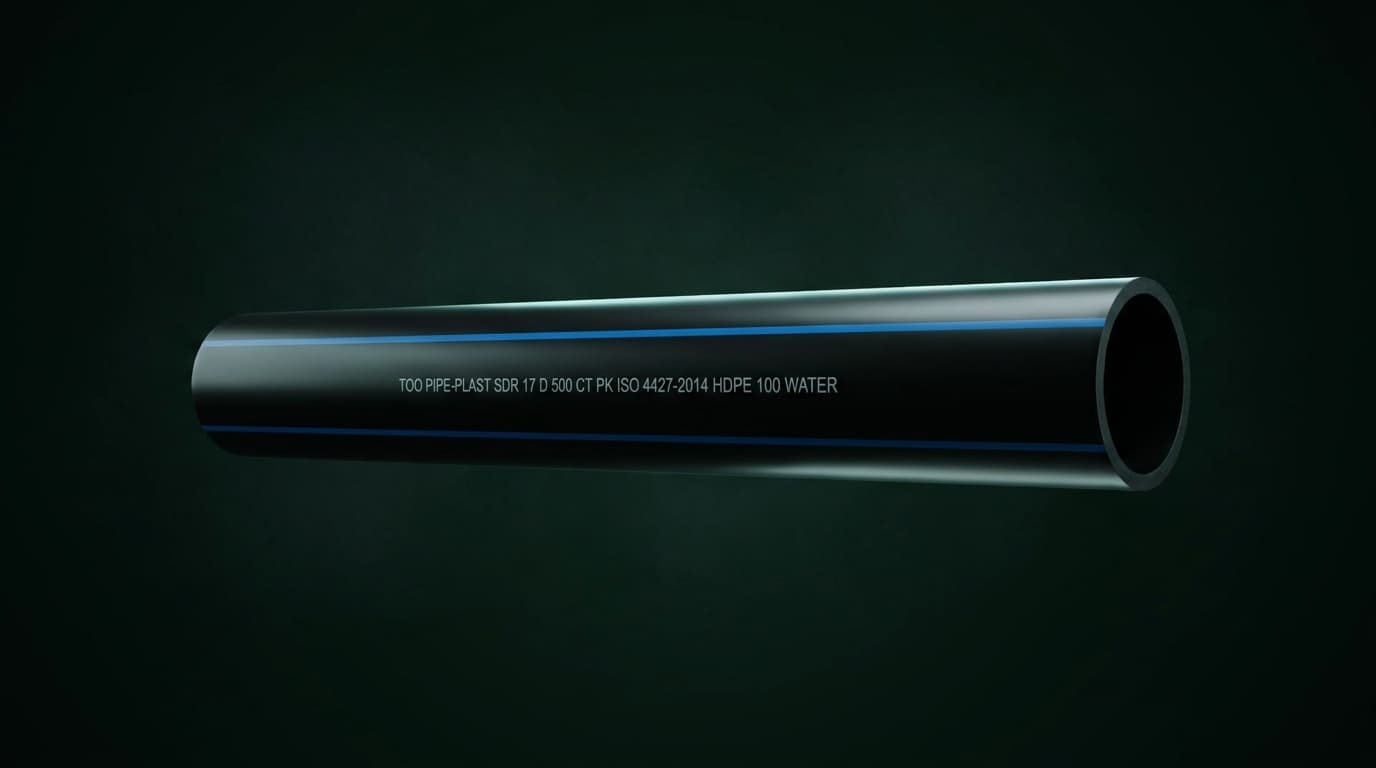
Polyethylene pipe (PE100) copes with freezing water best: the material is ductile, stretches slightly as ice forms and returns to size after thawing, and cold down to −60 °C does not harm it. Polypropylene is rigid and cracks more often when frozen, and metal-plastic deforms. But "frost-proof" does not mean "safe to freeze": the real risks are fittings, valves and ice plugs.
What happens to a pipe when the water in it freezes?
Water expands by roughly 9–10 % when it freezes. If there is room, ice simply takes it up. In a closed section between an ice plug and a closed valve, pressure rises and the weakest point takes the load: the pipe wall, a fitting or a shut-off valve.
This is why a metal pipe bursts: steel does not stretch. A ductile material behaves differently: the wall expands slightly and relieves the pressure, then returns to size after thawing. But this "elasticity" has a limit that depends on wall thickness, diameter and how fast the ice forms.
Which material copes with freezing best?
- Polyethylene (PE100). The best choice for outdoor water supply: ductile, does not become brittle in frost and usually survives a single freeze without bursting.
- Polypropylene (PPR). A rigid material: it does not stretch, so ice more often splits the pipe or a welded joint. It is used inside heated houses.
- Metal-plastic. The aluminium layer deforms and does not return to its original shape, and brass fittings often start to leak after thawing.
- PVC. Becomes brittle in frost and tolerates impact and ice poorly.
That is why polyethylene is chosen for water outside heated spaces. For drinking and utility water lines, PE100 SDR17 to GOST 18599-2001 is suitable — we manufacture such pipes.
Why does "frost-proof" not mean "safe to freeze"?
The ductility of the pipe does not protect the rest of the system. When thawing, it is usually not the straight runs that suffer but what sits next to them:
- threaded and compression fittings, where ice pushes the seal out;
- ball valves, mixers, filters and water meters, where water stays in the body;
- pumps and pressure tanks;
- repeated freezing: each ice–water cycle wears the material a little and shortens its life.
An ice plug also cuts off the supply, so there is no water in the system for as long as the frost lasts. A frozen pipe must not be hit, bent sharply or pulled: in frost, polyethylene tolerates impact worse. Installation is better done in warm weather.
How to lay a water line so that the water does not freeze?
The most reliable protection is to bury the pipe below the soil freezing depth. For Almaty it is usually around 1–1.2 m, in northern Kazakhstan 2 m and more. For your area, check the value against the building codes (SNiP/SP) and the design.
If burying is not possible, add protection to the section: a thermal insulation shell or a foamed polyethylene or PU foam sleeve, a heating cable under the insulation, a protective duct. House entries and sections near the foundation freeze fastest, so insulation matters most there. In an unheated house or dacha where nobody lives in winter, draining the system is more reliable. More in our articles on draining water for winter and insulating a dacha water line.
What to do if the pipe has already frozen?
First shut off the supply and leave a tap open: the melting water needs an outlet, otherwise pressure builds up behind the plug. Then warm the pipe gradually, always from the open end towards the closed one.
- Wrap the frozen section in cloth and pour warm, not boiling, water over it, or direct a stream of warm air from a household hair dryer at it.
- Do not heat the pipe with an open flame or a blowtorch: polyethylene melts and burns.
- Do not pass electric current through a plastic pipe: this method works only for metal.
- After thawing, inspect the fittings and valves.
If a pipe underground has frozen, call specialists: warming it with steam or flushing it with hot water through a thin hose can only be done with proper equipment.
Frequently asked questions
- Will an HDPE pipe burst if the water in it freezes once?
- Usually not: the material is ductile, the wall stretches and returns to size after thawing. Still, inspect the joints, valves and fittings: they are usually the first to be damaged.
- Does leaving a tap slightly open overnight help?
- Running water freezes less readily, so a thin trickle sometimes saves the line in a short frost. In severe frost, though, an unprotected section freezes anyway and the water is wasted. It is a temporary measure, not a substitute for burying and insulation.
- Will a polyethylene pipe outdoors survive −30 °C in winter?
- Yes, the material itself tolerates service down to −60 °C. The danger comes from ice inside, not from frost outside. An empty or protected pipe works through winter without problems. Transport and install carefully in severe frost: polyethylene tolerates impact worse.
- Why is a heating cable better than ordinary insulation?
- Insulation only slows cooling and will not protect in severe frost if the water stands still. A cable gives off heat and keeps the temperature above zero. So it is fitted where the pipe cannot be buried, and covered with insulation.