How to Patch a Hole in a Plastic Pipe: What Actually Works
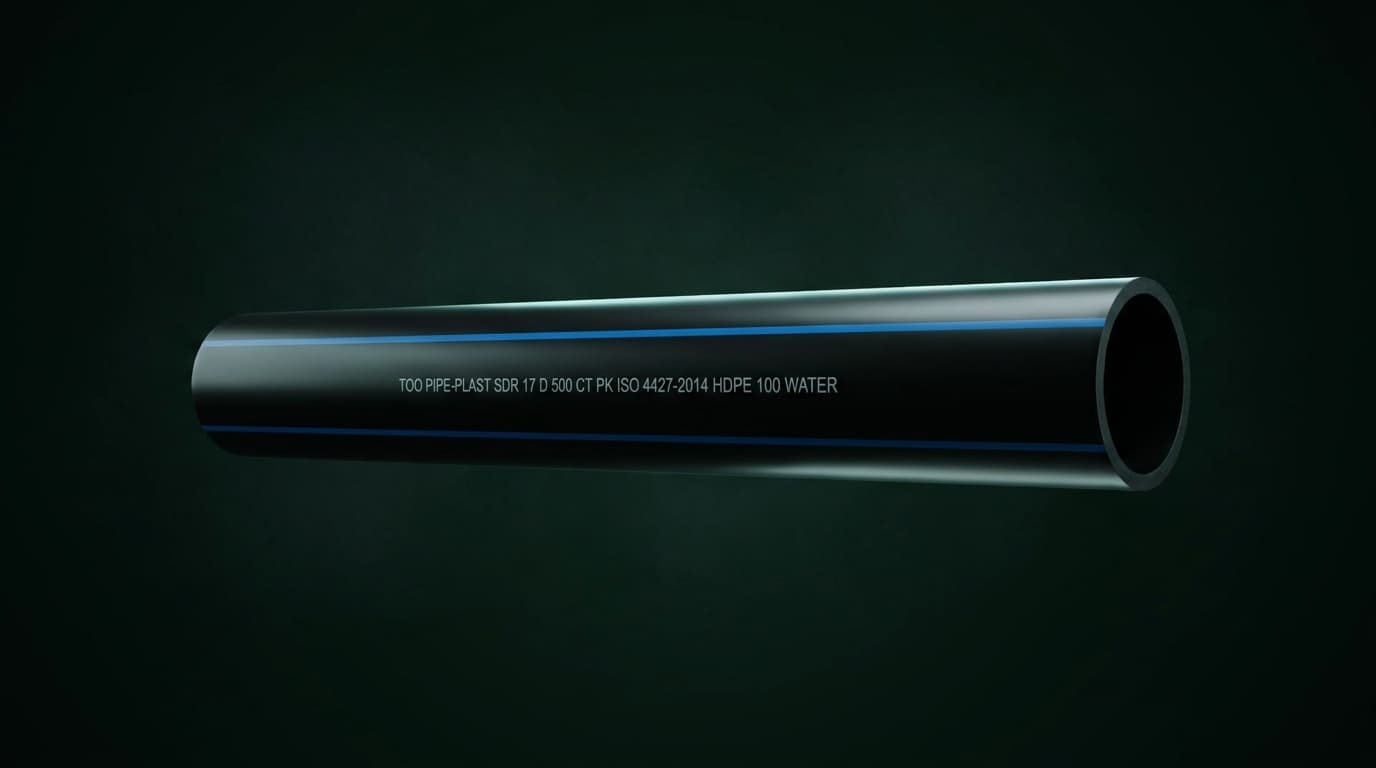
The only reliable fix for a hole in the pipe body is replacing the damaged section. Until you can, cover the hole with a repair clamp with a rubber gasket sized to the pipe diameter. Glue, sealant and cold weld hold poorly on polyethylene: PE has low adhesion, and the patch peels off under pressure. On polypropylene and PVC epoxy putty works better, but it is still only a temporary measure.
How is a hole in a pipe different from a leaking joint?
A leaking joint is a joint problem: the nut, the weld or the glue, and it is fixed by tightening or redoing the joint. A hole is damage to the pipe body itself: a nail or screw puncture, a drill hole made while fixing a shelf, a crack from impact, frost or overheating, damage from a spade or stone on a buried section. Tightening does nothing here. The first step is the same: shut off the water and relieve pressure. Then inspect the damage. A pinpoint puncture of 1 to 3 mm and a longitudinal crack need different handling: a crack keeps growing, so one patch is not enough and the section is better replaced.
What can you use to cover the hole temporarily?
Three methods work for a temporary seal.
- A repair clamp with a rubber gasket. The best option: choose it by the pipe's outside diameter, the gasket covers the hole with 2 to 3 cm margin each side, and the bolts are tightened crosswise.
- A wrap of thick rubber with ties or wire. Lay a rubber strip on the dry spot and wind it tightly. Suitable at low pressure.
- Epoxy putty or cold weld on PP and PVC. Abrade the surface, degrease it, apply the putty and wait for the full cure time in the instructions.
Check any patch immediately after turning the water on and again after a day.
Why do glue and cold weld hold poorly on polyethylene?
Polyethylene is a non-polar material with low surface energy: adhesives and sealants hardly bond to it. Epoxy putty may feel strong, but it peels at the boundary as soon as pressure, vibration or temperature swings appear in the pipe. Sanding and degreasing improve adhesion, but not enough for a patch to last for years. So on a PE pipe, including a black water pipe with a blue stripe, use a mechanical solution: a clamp or replacing the section. If you have applied epoxy anyway, treat it as a one-day measure and keep a clamp at hand. On polypropylene and PVC adhesion is noticeably better, but a thin patch on a pressure pipe is still temporary.
How do you replace the damaged section?
Procedure for a polyethylene pipe with compression couplings:
- Shut off the water and drain what remains.
- Cut out the damaged section with a pipe cutter, square, taking 3 to 5 cm of sound pipe on each side.
- Remove the inner burr and wipe the ends.
- Measure an insert from pipe of the same grade and diameter, allowing for the length of the couplings.
- Slip the nuts, clamping rings and seals onto the ends, push the pipe into the couplings until it stops and tighten.
- Open the water slowly, bleed the air and check the joints with a dry tissue underneath.
A polypropylene pipe is replaced with an insert on two socket-fused couplings, PVC with solvent-welded ones. On a buried PE main, electrofusion couplings are used.
How do you avoid another hole?
Before drilling walls and floors, find the pipe routes from the layout drawing or with a detector. Buried pipes are laid on a sand bed without sharp stones and below the soil frost depth; for Almaty it is usually about 1 to 1.2 m, but check the building codes and the project for your area. Do not leave an exposed plastic pipe in direct sunlight without protection or right next to hot surfaces: ultraviolet light and overheating shorten its service life. For water supply, PE100 SDR17 to GOST 18599-2001 is suitable, and we manufacture such pipes; black carbon-filled PE is UV resistant. If a gas pipe is damaged, only the gas service carries out the repair.
Frequently asked questions
- Can you patch a hole without shutting off the water?
- Only as an exception and temporarily: at low pressure a clamp is sometimes fitted on a live pipe, but it is hard to tighten and the jet washes out the gasket. It is safer to shut off the water, which takes a minute.
- Can you weld a hole in a PE pipe with a soldering iron or heat gun?
- Polyethylene can be welded, but with special equipment, controlled temperature and surface preparation. A patch melted on with a soldering iron or a heat gun gives poor fusion and comes apart under pressure, so it cannot be considered reliable.
- How long will a repair clamp last?
- A correctly chosen clamp with a good gasket holds for months, but it remains a temporary measure: rubber ages and bolts loosen. The permanent repair is replacing the section. On a buried pipeline a clamp is not left in place: it cannot be monitored.
- What to do about a hole in a hot water or heating pipe?
- Stop circulation and let the system cool, then replace the section. Water-supply PE100 is rated for water up to +40 °C, while hot water supply and heating use PP and other systems: repair them with a welded coupling or a fitting rated for the system temperature.