How to Insulate a Dacha Water Line: Burying, Shells, Cable
The most reliable way to protect a dacha water line is to bury the pipe below the soil freezing depth (in Almaty usually around 1–1.2 m, in northern Kazakhstan 2 m and more). If burying is not possible, fit a thermal insulation shell of PU foam or foamed polyethylene with waterproofing and add a heating cable. Protect house entries, wells and caissons separately: that is where water freezes first.
Which method should you choose to insulate a dacha water line?
The choice depends on how you use the dacha. If water is needed all year round, the line must be reliably protected, and the main method here is burying. If the dacha is seasonal and empty in winter, it is easier to drain the water than to insulate; this is covered in our article on draining water for winter.
In order of reliability the methods are:
- burying the pipe below the freezing depth;
- burying not to full depth plus insulation on top;
- a heating cable with thermal insulation;
- insulation without heating, only for short sections and light frosts.
Insulation does not create heat itself; it only slows cooling.
How to protect a water line by burying it?
Burying protects from frost without maintenance or electricity costs. The freezing depth is determined by region: for Almaty usually around 1–1.2 m, in northern Kazakhstan 2 m and more. For your plot, check the value against the building codes (SNiP/SP) and the design.
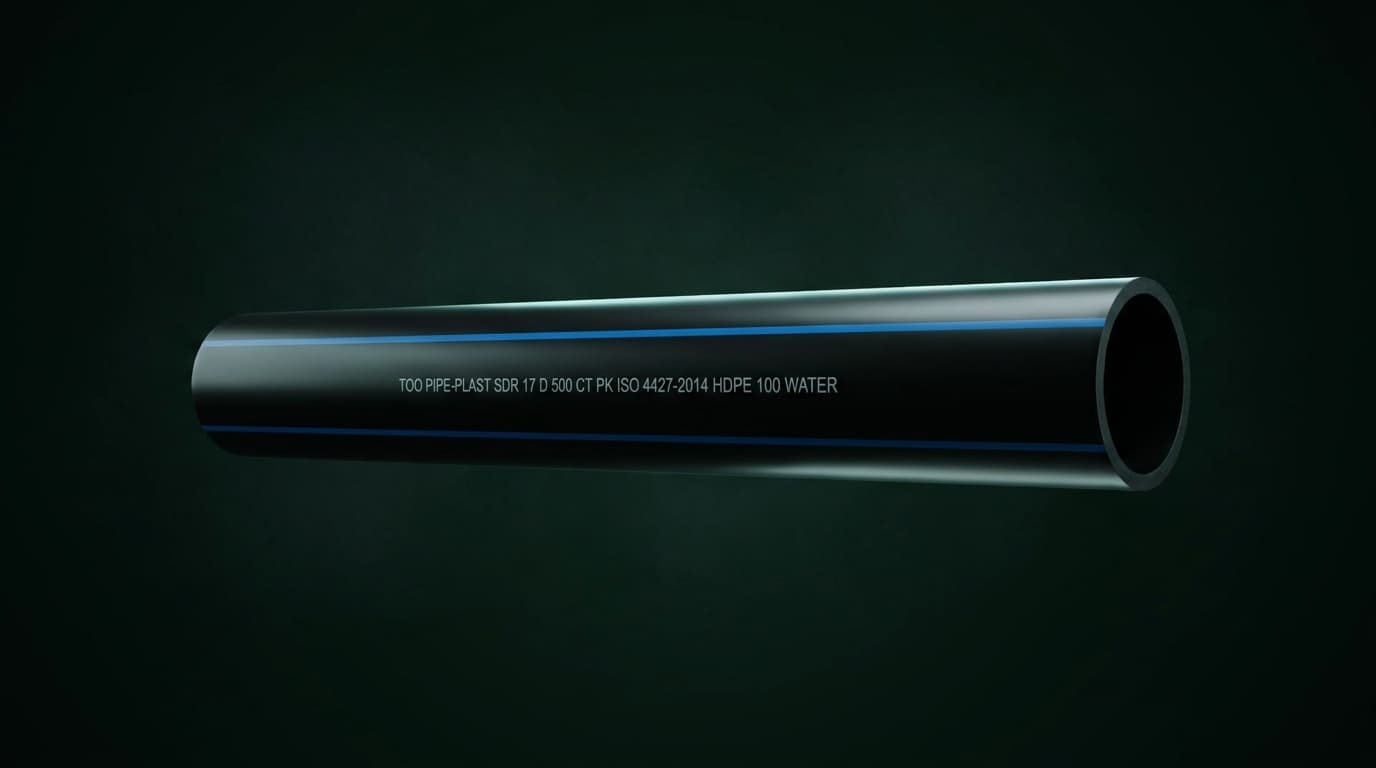
If a deep trench is not possible, the pipe is laid shallower and protected from above: on the sand bedding above the pipe, lay extruded polystyrene boards wider than the trench so that cold does not come in from the sides. For drinking and utility water, PE100 SDR17 to GOST 18599-2001 is suitable: we manufacture such pipes and supply them in coils up to 200 m, so a trench often needs no joints at all. Backfill without stones and construction debris.
What to insulate the pipe with: shell, PU foam, foamed polyethylene?
For cold water pipes, shells of polyurethane (PU) foam are most often used: they wrap the pipe tightly, have low thermal conductivity and are protected from moisture by a layer of foil or glass cloth. They are fitted with adhesive and clips, and the joints are taped so that no unprotected spots remain. Shaped shells are convenient on bends and fittings.
Foamed polyethylene tubes are cheaper and simpler but thinner. Unprotected mineral wool quickly gets wet and loses its insulating properties; roofing felt is also a poor choice. Install on a dry pipe in dry weather: moisture under the insulation cancels the protection. Over the insulation in the ground a sleeve or corrugated pipe is needed so that soil does not damage the layer.
How does a heating cable work and how is it installed?
A heating cable is laid along the pipe and keeps the temperature in it above zero. For plastic pipes a self-regulating cable is used, chosen by permitted temperature and pipe type; its heat output rises in cold and falls in warmth, so the risk of overheating is lower.
- Choose a cable that is approved for plastic pipes and for contact with drinking water lines, and select the length to match the line.
- Fix the cable along the pipe with aluminium tape or ties following the manufacturer's instructions.
- Install a thermostat or temperature sensor.
- Always put thermal insulation with waterproofing over it.
- Connect through a circuit breaker and an RCD; it is better to leave power and connection to an electrician.
If the cable is not self-regulating, do not cross it over itself, and do not switch it on coiled up.
How to protect entries, wells and caissons?
Usually it is not the whole line that freezes but the weakest points: where the pipe enters the house through the foundation, the exit from a borehole or well, sections near the surface, and places where the line goes from ground to air. Insulation and heating are needed here first.
- House entry. Pass the pipe through a sleeve in the foundation and insulate it along the whole approach; seal the gap.
- Borehole and well. Insulate the well head, fit a caisson with an insulated lid and, if needed, a small heater.
- Surface sections. Cover them with a duct with insulation inside so that the pipe is not exposed to wind.
- Taps and fittings in unheated rooms are insulated in the same way as the pipe.
Frequently asked questions
- Does high pressure in the pipes stop water from freezing?
- No: water under pressure freezes at practically the same temperature. The method with a receiver and 3–5 atmospheres appears in old advice, but it does not protect and puts load on pipes and joints. Do not use it.
- Can a pipe be insulated with mineral wool?
- Only with reliable waterproofing: exposed wool in the ground or in the air gets wet and stops insulating. PU foam shells or foamed polyethylene with a protective cover are far more practical: they do not absorb water and keep their shape.
- How much electricity does a heating cable use?
- It depends on the power per metre and the line length: a self-regulating cable draws more in frost and less in warmth. Take exact figures from the cable data sheet and calculate for your length and mode.
- Do I need to insulate the pipe if I drain the water for winter?
- No: an empty pipe will not freeze. Insulate the sections where water stays: entries, taps, filters and appliances that are hard to dry out completely. A well or caisson with the borehole head is also better insulated.