How to Bend a Plastic Pipe and Can You Heat HDPE Pipe
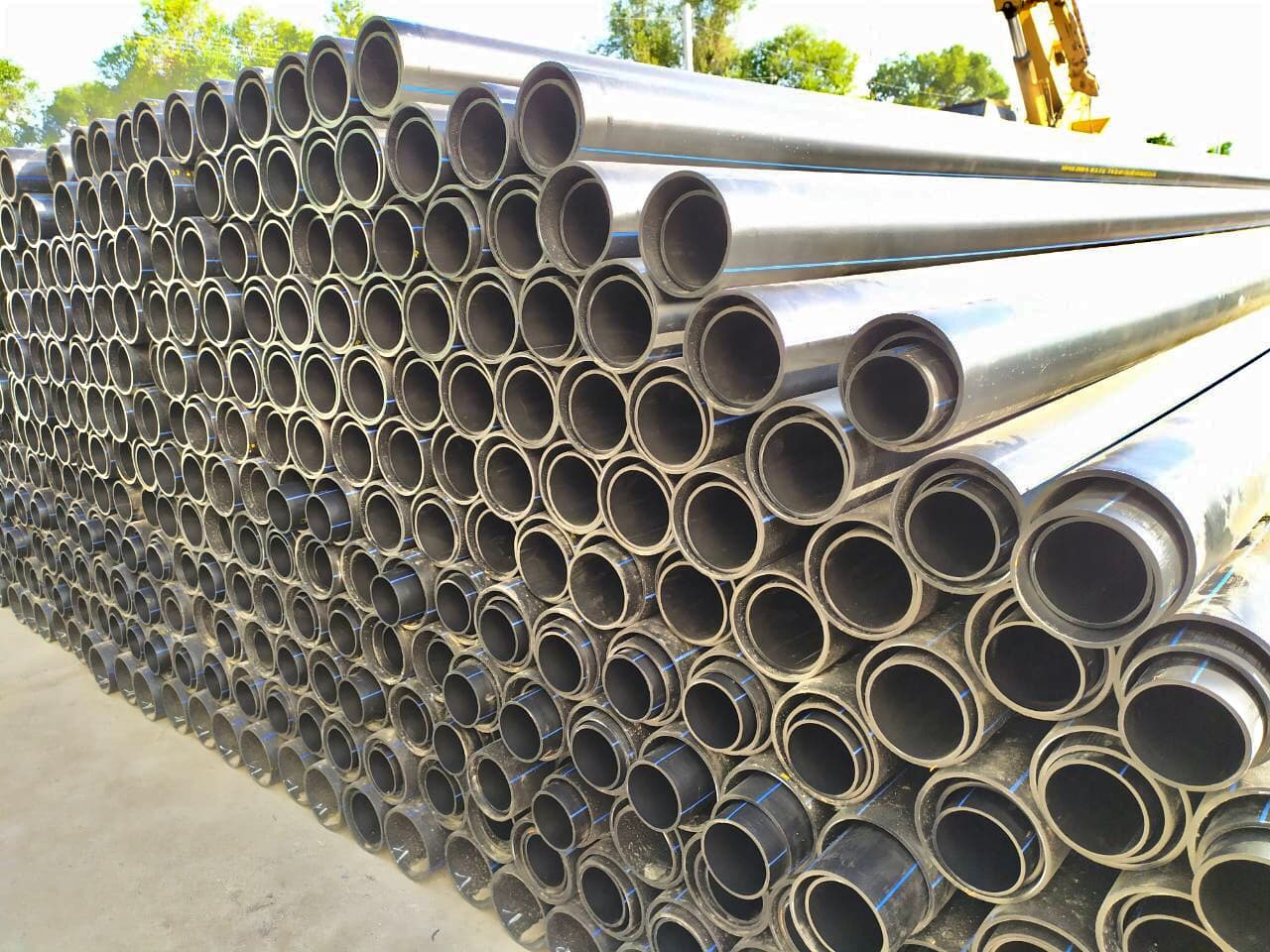
Polyethylene pipe is bent gradually and without heating: usually to a radius of at least 20–25 outside diameters for SDR11–17, with the exact value given by the manufacturer. Do not heat a pressure HDPE pipe with an open flame or a construction heat gun: it overheats, the wall thins and service life drops. For a sharp turn, fit a 45° or 90° elbow. Large-diameter pipes are bent only to a large radius.
Can you heat an HDPE pipe to bend it?
Polyethylene is a thermoplastic: it softens when heated and hardens again as it cools, so technically it can be heated and bent. But for a pressure pipe it is a bad idea. PE melts at around 125–135 °C and softens noticeably earlier. With uneven heating the wall thins at the bend, internal stresses are left in the material, and after cooling the pipe tries to return to its former shape.
For water mains, and even more for gas, where a guaranteed service life matters, heating is not used. It is acceptable only for non-pressure and decorative tasks, and only on the pipe manufacturer's advice.
Why not use an open flame or a construction heat gun?
- A torch, blowtorch or lighter gives local overheating: the polyethylene chars, blackens and gives off soot, and bubbles and weak spots form in the wall.
- A construction heat gun blows too hot a stream, unevenly: the surface overheats before the whole wall has warmed through.
- In a bend the wall is stretched on the outside and compressed on the inside; in a softened state the pipe flattens (ovalises) and the cross-section shrinks.
- On pipes with a protective sheath heating is especially undesirable: the layers may separate.
- A hot pipe must not be buried or loaded at once: it should cool naturally, without being hosed with water.
What bending radius is allowed without heating?
A guide for PE100 pressure pipes SDR11–17 at above-zero air temperature is at least 20–25 outside diameters: nearer 20 for SDR11 and nearer 25 for the thinner-walled SDR17. For a d63 pipe that is a radius of about 1.3–1.6 m, for d110 about 2.2–2.8 m, for d160 about 3.2–4 m.
In frost the pipe is stiffer and the radius is increased. The thinner the wall (the higher the SDR), the more easily the pipe flattens in a bend, so allow extra radius for it. This is a guide, not a standard: confirm exact values against the manufacturer's recommendations and the design. We supply small diameters in coils of 50–200 m, which lay in an arc without effort; large diameters come as straight lengths of 6–12 m, and turns on them are made with a large radius or an elbow.
How do you bend a large-diameter pipe without heating?
- Determine the required radius and mark the route on the ground or on the trench bottom.
- Choose a warm day: in sub-zero temperatures the pipe is stiffer and the radius has to be increased.
- Lay the pipe on a level surface free of stones and let it come to air temperature.
- Bend it gradually over the whole length of the section, not at one point, and support the pipe on both sides so that it does not sag.
- Watch that no kink or flattening occurs. If a crease or a whitish stress line appears, that section is cut out and replaced with a sound one.
- Fix the bent section in the trench with stops or sand backfill so that it does not straighten.
When do you need an elbow instead of a bend?
If there is no room for a gentle arc, the turn is sharp, or the pipe is thin-walled and large in diameter, fit an elbow: a ready-made fitting at 45°, 90° or another angle. For small diameters and water, compression elbows will do; for large ones, segmented welded or moulded elbows joined by butt fusion or through an electrofusion coupling.
Polyethylene gas pipes are never bent or heated by yourself: every turn of a gas main is designed and installed by a licensed organisation, and acceptance is carried out by the gas service.
Frequently asked questions
- Can an HDPE pipe be softened with boiling water?
- Boiling water softens polyethylene unevenly and only briefly, and bending stresses in the wall remain anyway. For pressure pipes this method is not recommended: it is more reliable to increase the radius or fit an elbow.
- How do you straighten a pipe from a coil?
- Unroll the coil in warm weather and let the pipe warm to air temperature. Lay it with a slight snake and hold it down with soil or stops. There is no need to heat it to straighten it.
- What if the pipe has kinked and a crease has appeared?
- A crease is damage to the wall and cannot be fixed by heating. The section is cut out, with some spare length on both sides of the crease, and replaced with a sound piece, joined with couplings of a suitable type.
- Can a pipe be bent in frost?
- Yes, but carefully: the pipe is stiffer, the radius must be increased, and the bending should be slow and free of impact. If in doubt, wait for warmer weather or fit an elbow: for a thin-walled large-diameter pipe in winter this is the most reliable option.