What Diameters of Plastic Pipes Exist
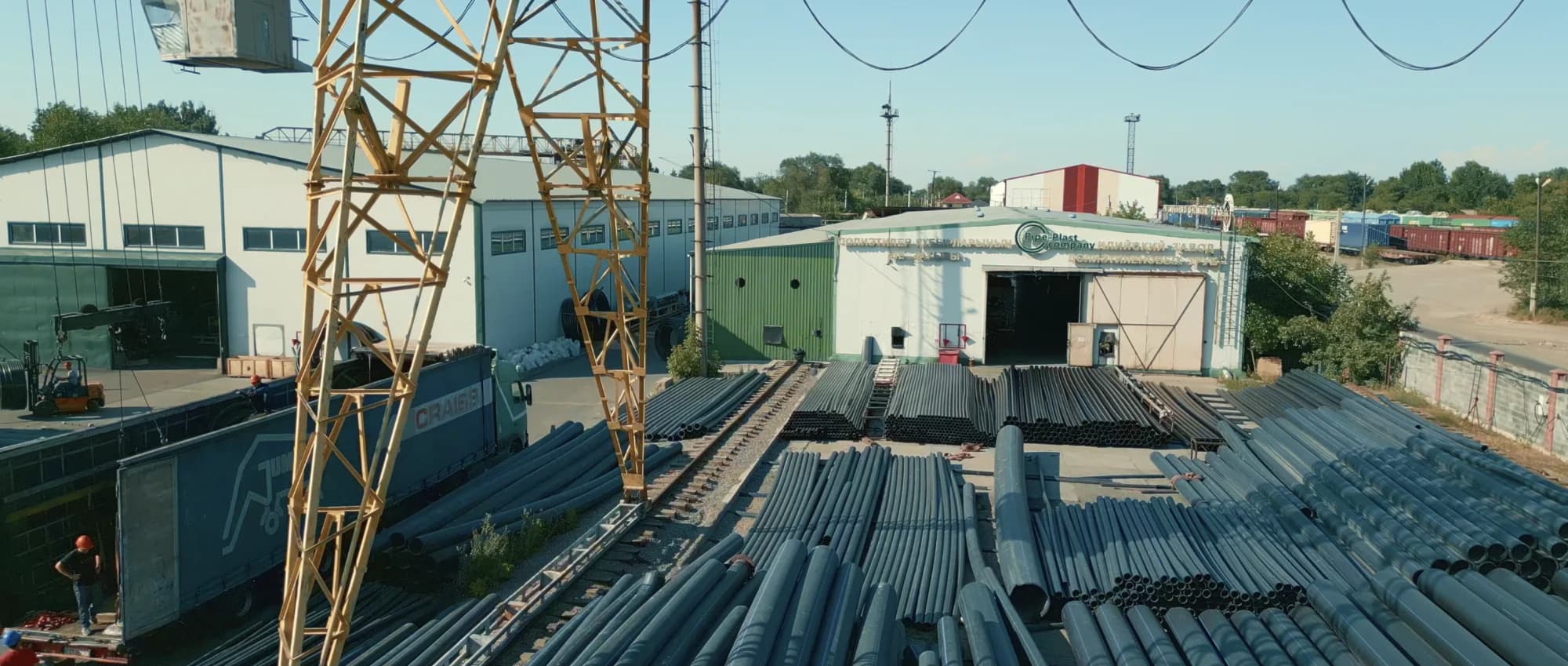
Polyethylene pipe diameters under GOST 18599-2001 are given as outside diameter: 20, 25, 32, 40, 50, 63, 75, 90, 110, 125, 140, 160, 180, 200, 225, 250, 280, 315, 355, 400, 450, 500, 560, 630, 710, 800, 900, 1000 and 1200 mm. For a house and plot, 20–63 mm is most common; for mains, 110 mm and above. Pipe-Plast makes pipes from 20 to 1200 mm.
How does outside diameter differ from nominal bore?
For polyethylene pipes the main dimension is the outside diameter d. It is stated in the marking together with the wall thickness, for example 110 × 6.6. This follows from installation: fittings and couplings fit onto the outer surface of the pipe.
Nominal bore (DN) is a rounded nominal cross-section size used to select valves and to compare pipes of different materials. For PE pipes it is roughly close to the inside diameter but not equal to it. Inside diameter is d minus two wall thicknesses, so for pipes of the same outside diameter but different SDR it differs.
What is the diameter range of PE pipes?
Under GOST 18599-2001 the range of outside diameters of PE pipes is: 20, 25, 32, 40, 50, 63, 75, 90, 110, 125, 140, 160, 180, 200, 225, 250, 280, 315, 355, 400, 450, 500, 560, 630, 710, 800, 900, 1000 and 1200 mm. It can be loosely divided into groups:
- 20–63 mm: domestic and garden water supply, service lines to a house. Supplied in coils of 50–200 m;
- 75–160 mm: village service entry, street branches;
- 180–315 mm: distribution networks;
- 355–630 mm: mains and conduits;
- 710–1200 mm: large conduits and pressure collectors.
Large diameters are supplied in straight lengths of 6–12 m. Pipe-Plast produces PE100 in diameters 20–1200 mm.
How are wall thickness and SDR related?
SDR is the standard dimension ratio: the outside diameter divided by the wall thickness (SDR = d / s). The lower the SDR, the thicker the wall and the higher the pressure. For PE100 these are SDR17 (about 10 atm), SDR13.6 (about 12.5 atm) and SDR11 (about 16 atm).
Examples of wall thickness:
- d32, SDR11: 3.0 mm;
- d63, SDR17: 3.8 mm; SDR11: 5.8 mm;
- d110, SDR17: 6.6 mm; SDR11: 10.0 mm;
- d160, SDR17: 9.5 mm;
- d630, SDR17: 37.4 mm.
The inside diameter of a d110 SDR17 pipe is 110 − 2 × 6.6 = 96.8 mm. So when selecting by flow capacity, look not at the outside diameter alone but at the pair of d and SDR.
What diameter do you need for a house, a plot and a main?
Guidelines for typical tasks:
- Water service to a house and distribution around a plot: 32–50 mm;
- irrigation and garden branches: 20–32 mm, a main up to the well 40–63 mm;
- water supply for a village, service entry to a block: 110–315 mm;
- trunk water mains: 355 mm and above;
- outdoor sewer of a private house: 110 mm (gravity pipes follow other standards).
For gas, the diameter and SDR are set by the gas utility's design. Choose the diameter for the flow so that water velocity is roughly 1–1.5 m/s: lower and you overpay for pipe; higher and pressure losses grow. The exact choice is a hydraulic calculation.
How do you find the diameter of a pipe that is already installed?
If you need a fitting for an existing pipe, measure the outside diameter:
- Wrap a flexible tape or cord around the pipe and measure the circumference.
- Divide it by 3.14.
- Round the result to the nearest value in the range: 32, 40, 50, 63, 75, 90, 110 and so on.
- Read the marking on the pipe wall: it usually shows the diameter, wall thickness or SDR, material and standard.
Measuring with callipers is more convenient, but a tape also works on a large pipe. To compare with the inch threads of steel pipes, use a conversion table: there is no direct equality.
Frequently asked questions
- How does DN differ from d in a PE pipe marking?
- d is the pipe's outside diameter, DN is the nominal bore, a rounded nominal value. PE pipe markings state d and the wall thickness, for example 63 × 3.8.
- What inch sizes do PE pipes correspond to?
- Approximately: d20 — 1/2″, d25 — 3/4″, d32 — 1″, d40 — 1 1/4″, d50 — 1 1/2″, d63 — 2″. This is a guide for choosing adapters, not an exact equality, because steel pipes are measured by nominal bore.
- How do I choose a diameter for the required water flow?
- By flow velocity of 1–1.5 m/s and the inside diameter. Flow = cross-sectional area × velocity. For long lines and pump systems a hydraulic calculation that includes friction losses is needed.
- Are pipes of intermediate diameters made?
- No, diameters are standardised by the GOST range and there are no intermediate sizes. If you need a non-standard flow capacity, choose the next larger diameter or a different SDR with another wall thickness.