How to Choose Pipe Diameter for a Private House Water Supply
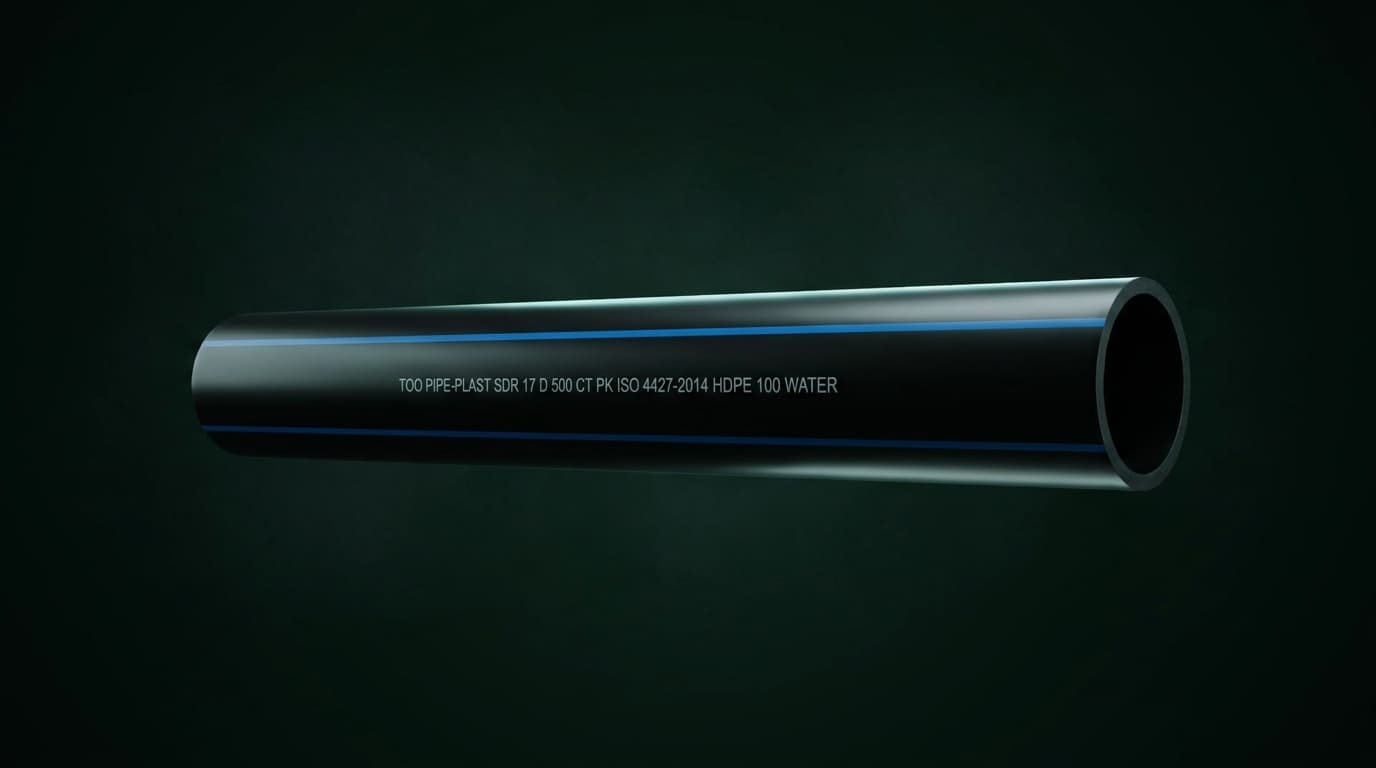
For a private house the water inlet is usually a 25–32 mm pipe, the main across the plot 32–40 mm, and the indoor distribution 16–20 mm (in other materials). Choose the diameter from peak water demand, route length and available pressure: at a flow velocity of about 1 m/s a 32 mm pipe carries roughly 30–35 L/min. That is enough for a house with two or three taps open at once.
What does the water pipe diameter depend on?
Diameter determines how much water a pipe can carry without a noticeable pressure loss. Several factors affect the choice:
- peak demand: how many taps, showers and machines run at the same time;
- route length: the longer it is, the greater the friction loss;
- the number of bends, valves and fittings, each of which adds resistance;
- the pressure at the source or the pressure a pump creates;
- the number of residents and guests and, for a plot, irrigation too.
A single mixer tap usually gives 5–10 L/min, so you count the likely simultaneous load, not the sum of all fixtures.
What diameter is needed for the inlet, the plot and indoor runs?
Guide values for a single-family house with cold water and polyethylene pipe:
- house inlet: 25–32 mm;
- main across the plot serving several points (house, bathhouse, irrigation): 32–40 mm;
- distribution inside the house: 16–20 mm.
PE pipe is usually not used for indoor distribution: polypropylene, PE-X or multilayer pipe is taken there, while PE100 stays for the outdoor part and the inlet. If one pipe feeds two houses or a large irrigated plot, go one size up, to 40–50 mm. A calculation or a design confirms the final size.
How do you estimate a pipe's carrying capacity?
Flow equals the inner cross-section area multiplied by the flow velocity. In private networks the velocity is taken at about 0.7–1.5 m/s: lower and the pipe is underused, higher and head loss and noise grow.
Roughly, at about 1 m/s:
- 25 mm pipe (SDR11) — about 20 L/min;
- 32 mm pipe — about 30–35 L/min;
- 40 mm pipe — about 50 L/min.
These are orders of magnitude, not datasheet values: the exact figure depends on wall thickness. If your peak demands add up to 25–30 L/min, a 32 mm pipe is enough; if more, take 40 mm.
How do you find the inner diameter from the marking?
A polyethylene pipe is marked with its outer diameter and wall thickness, for example 32×2.0. The inner diameter is the outer one minus two wall thicknesses: 32 − 2 × 2.0 = 28 mm. It is this figure that sets the carrying capacity.
Wall thickness depends on SDR, the ratio of diameter to thickness. The lower the SDR, the thicker the wall, the higher the pressure rating and the narrower the bore. For water, SDR17 (about 10 atm) or SDR13.6 (about 12.5 atm) is usually chosen, and SDR11 (about 16 atm) for higher pressure. Sizes and classes of water pipes are set by GOST 18599-2001; we make such PE100 pipes.
Why is a pipe with a margin not always better?
A margin in diameter is sensible, but an oversize pipe has drawbacks. Large pipe and fittings cost more, and at low demand the velocity inside drops: the water stands longer and warms up in summer. For larger diameters, welding has to replace simple compression joints.
Too small a diameter is harmful as well: pressure at the far taps drops, and the pump runs louder and under more load. A sensible scheme is larger at the start of the route, where all the flow passes, and thinner in the branches to individual fixtures. Small diameters come in coils of 50–200 m, so the inlet can be laid as one piece with no joints.
How do you check the diameter choice before buying?
- List the water points and estimate peak demand, remembering that only part of the fixtures run at once.
- Measure the route length from the source to the farthest point.
- Choose the diameter from a flow velocity of 0.7–1.5 m/s and check the inner diameter from the marking, not the outer one.
- Determine the pressure: pump or mains head plus a margin for water hammer, and pick the PN class.
- Add a small margin for future needs: irrigation, a bathhouse, a second bathroom.
If you doubt the size, send us the route length and the list of points on WhatsApp +7 707 755 54 07 and we will suggest a diameter and a pressure class for PE100.
Frequently asked questions
- Is a 32 mm pipe enough for a house with two bathrooms?
- Usually yes, unless there is heavy irrigation: 32 mm at about 1 m/s gives roughly 30–35 L/min, and more than three or four points rarely run at once in a house. If a bathhouse and an automatic irrigation system are nearby, plan 40 mm or calculate the demand in a design.
- What pressure rating should a water pipe have?
- For a private house PN10 (SDR17) is most often enough. With a high-head pump, deep burial or water hammer, take PN12.5 or PN16. Choose the pressure class with a margin over the system's working pressure.
- Does route length affect the choice of diameter?
- Yes. The longer the pipe, the greater the friction pressure loss. For a route of 100 m or more it makes sense to go one size up compared with a short inlet, especially when water flows by gravity or from a weak pump.
- Can PE pipe be used for indoor distribution?
- For cold water it can, but indoors polypropylene, PE-X or multilayer pipe is usually used: they are easier to run along walls and allow hot water. PE pipe is not suitable for hot water or heating, only for cold water up to +40 °C.