01
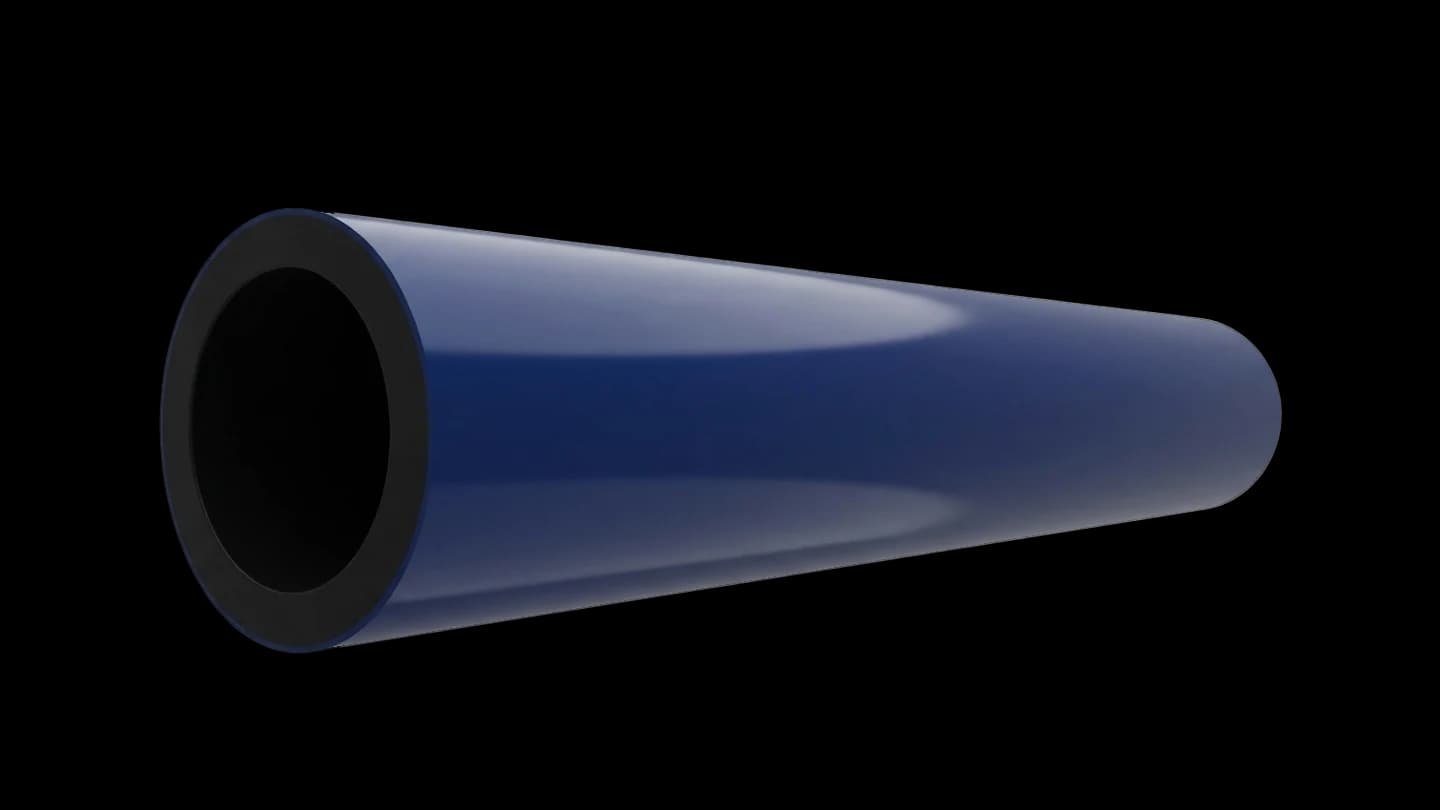
For water
black PE100 wall · blue PP sheath
Drinking and utility water supply. The sheath lets the pipe be pulled without a sand bed.
PE100 pressure pipes with an extra sheath of impact-resistant polypropylene: a continuous +1.5–2 mm jacket over the design wall — for trenchless installation and for laying in difficult ground without sand bedding.
Need another diameter, class or coil supply? Request a quote →
The polypropylene sheath goes on cold, as a separate layer over the finished PE100 pipe, adding 1.5–2 mm of protection. Its colour marks the service. Diameters 200–630 mm.
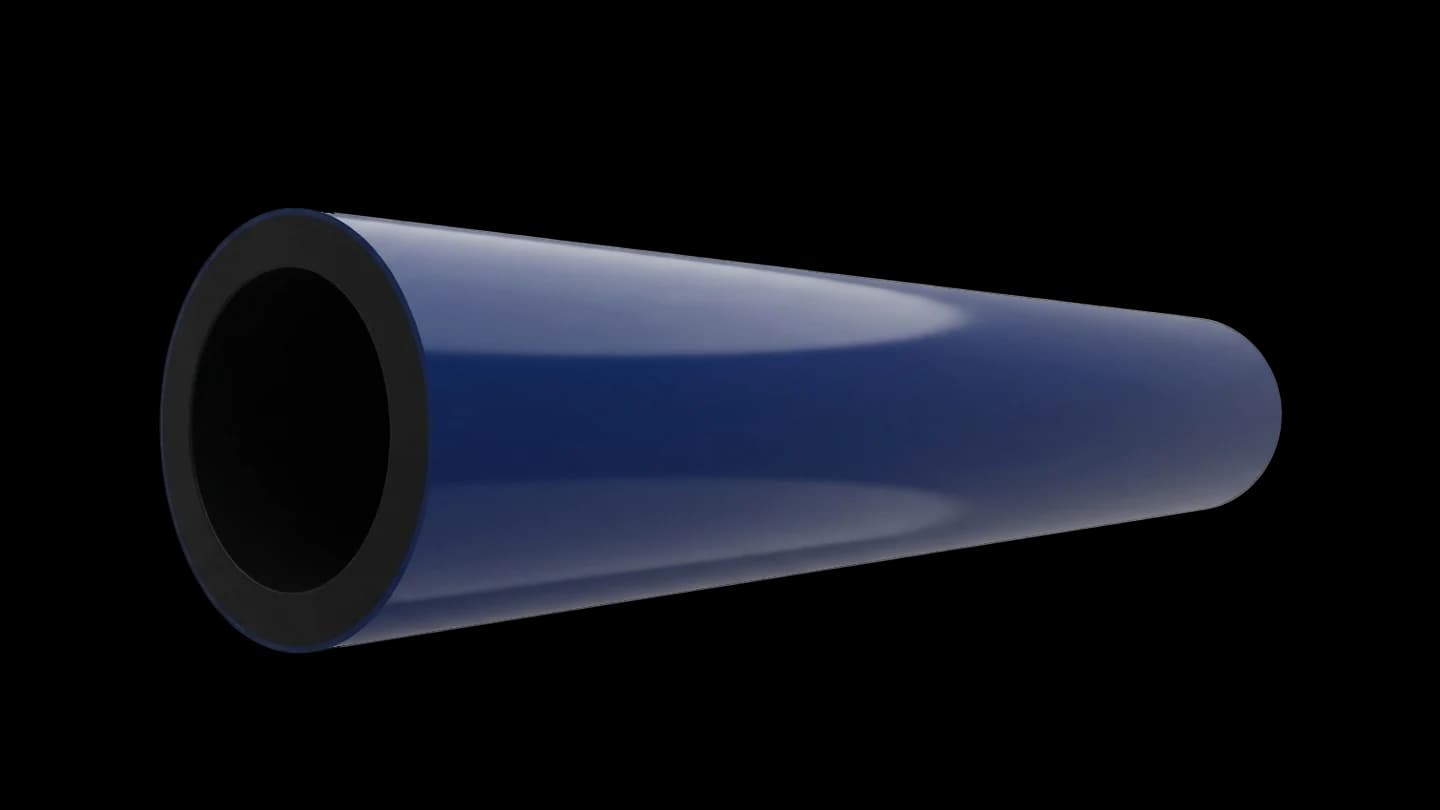
black PE100 wall · blue PP sheath
Drinking and utility water supply. The sheath lets the pipe be pulled without a sand bed.
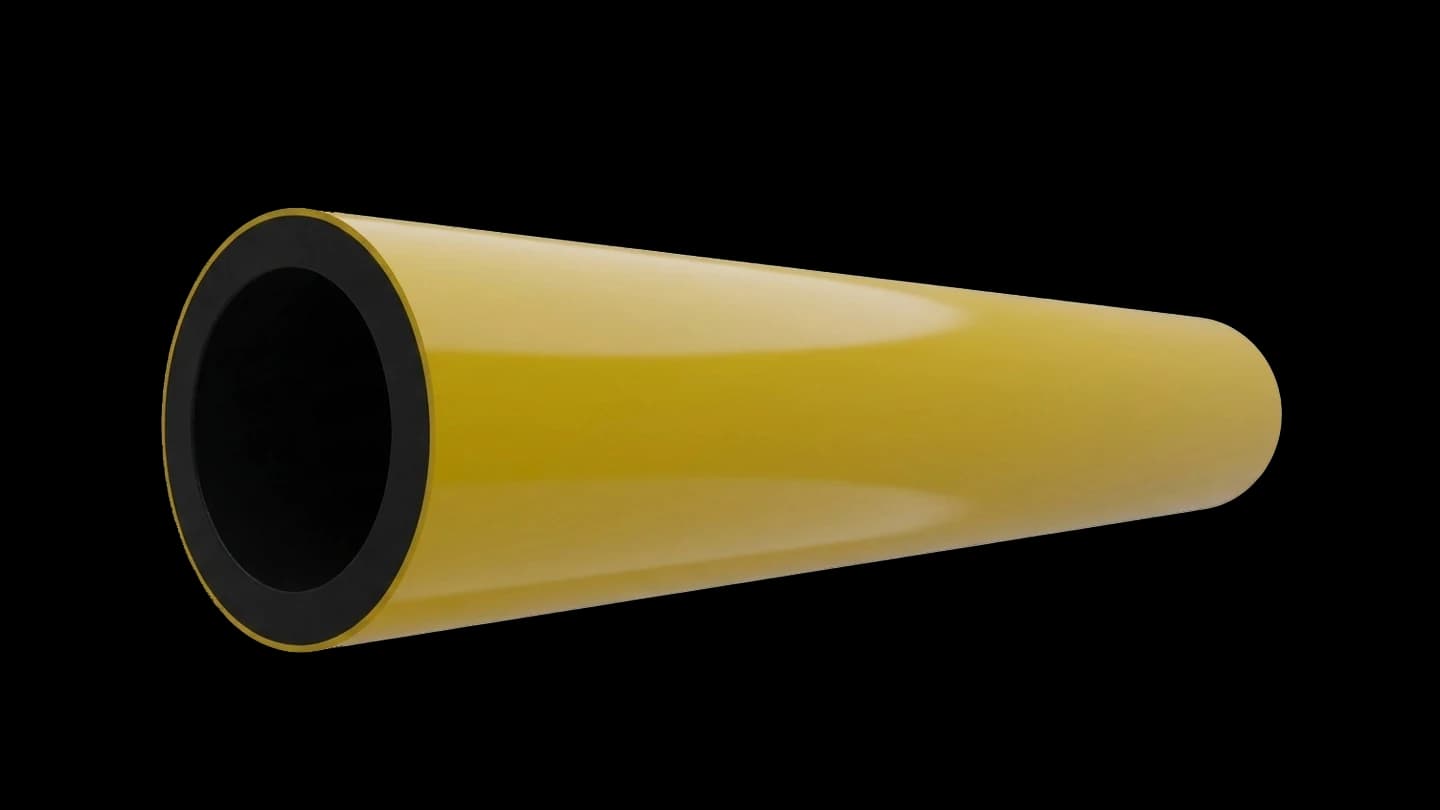
black PE100 wall · yellow PP sheath
Gas distribution networks. The same protective layer in yellow marking.
It is the same PE100 pressure pipe — the difference is the protective layer and the way it is stripped before welding.
The PE100 carrier pipe takes the working pressure, while the polypropylene sheath absorbs external mechanical damage. The sheath is not part of the design wall: SDR and pressure class are selected exactly as for a standard pressure pipe.
Before butt welding or electrofusion the protective layer is stripped off the pipe ends with a dedicated peeling tool, exposing clean, undamaged pressure pipe. The pipe needs no special welding equipment.
The PP sheath is a continuous jacket of impact-resistant polypropylene, 1.5–2 mm thick, applied over a finished PE100 pipe. It is not part of the design wall: the polyethylene carries the pressure, while the polypropylene absorbs abrasion, impact and contact with sharp ground. SDR and pressure class are therefore selected exactly as for a standard pressure pipe, and the sheath is only counted in the outside diameter — when choosing fittings, casings and the bore diameter for HDD. Production range is d200–630 mm; Pipe-Plast is the only producer of these pipes in the region.
Horizontal directional drilling, piercing and pulling; water mains, gas mains and pressure sewers; laying in rocky, frost-heaving and unstable soils; pipeline rehabilitation by the pipe-in-pipe method.
Horizontal directional drilling, piercing, pulling through the bore.
Water mains, gas mains and pressure sewers.
Rocky, frost-heaving and unstable soils.
Relining of worn-out pipelines.
The economics of this pipe are decided during earthworks and on trenchless crossings.
The protective layer rules out damage to the carrier pipe from gravel and sharp stones, so the trench is backfilled with local soil. That removes the cost of buying, hauling and compacting sand.
During trenchless installation and pulling through the bore, scratches and chips stay on the outer polypropylene layer. The PE100 working pipe keeps its factory wall thickness and structural integrity.
There is no need to excavate extra soil for bedding: earthworks shrink, less heavy equipment is involved and the site is handed over sooner.
The outer polypropylene layer shields the polyethylene from sunlight, so pipes can be stored on open construction sites without losing their physical and mechanical properties.
With no damage or point loading on the carrier pipe, the design service life of 50 years holds even when the ground shifts or deforms.
A polypropylene-sheathed pipe is a standard polyethylene pipe with an additional protective layer of polypropylene applied over the already-cooled pipe (plus 1.5–2 mm to the wall). The sheath protects the pipe from mechanical damage during trenchless installation, pulling and laying in soils with inclusions. Pipe-Plast manufactures PP-sheathed pipes in diameters d200–630 mm — a unique offering in the region: other plants apply protective coating only up to d160 mm. Important: a sheathed pipe is not a multi-layer pipe; the sheath is applied in a separate cold operation, whereas in a co-extruded pipe the layers bond while still in the hot melt. Both products are rated for a 50-year service life and come with GOST conformity certificates.
Before welding, the PP sheath is removed in the joint area — usually with a dedicated stripping tool or a knife, over a length sufficient for facing and alignment. Butt fusion then follows the standard PE100 procedure, with the usual parameters for the given diameter and SDR.
For electrofusion joints the sheath is stripped to the coupler length and the polyethylene is scraped as usual. After installation the stripped areas can be protected with a heat-shrink sleeve if required. The pipe needs no special welding equipment.
A PP sheath protects the surface against abrasion and gouging; it pays off above all when pulling by HDD or relining and when laying into fill and gravel soils. A co-extruded pipe solves a different task — the resistance of the wall material itself to slow crack growth caused by point loads.
If a section combines both factors — a long pull and aggressive soil — the design is selected per project, and it is worth agreeing the solution with a manager. Pipe-Plast produces both lines in diameters of 200–630 mm.
The production range is d200–630 mm, the base class is SDR17 (10 bar), with SDR13.6 and SDR11 available to order. The protective sheath is 1.5–2 mm on top of the design wall, which has to be allowed for when selecting fittings, casings and the borehole diameter for directional drilling.
The base pipe complies with GOST 18599-2001 / ST RK ISO 4427-2014 for water supply and ST RK GOST R 50838-2011 / ST RK ISO 4437-2014 for gas. Each batch comes with a quality passport and a certificate of conformity; the full document package is suitable for tenders and public procurement.
Price depends on the product spec. Call or leave a request — our team will pick the diameter, stiffness and quantity and arrange delivery.